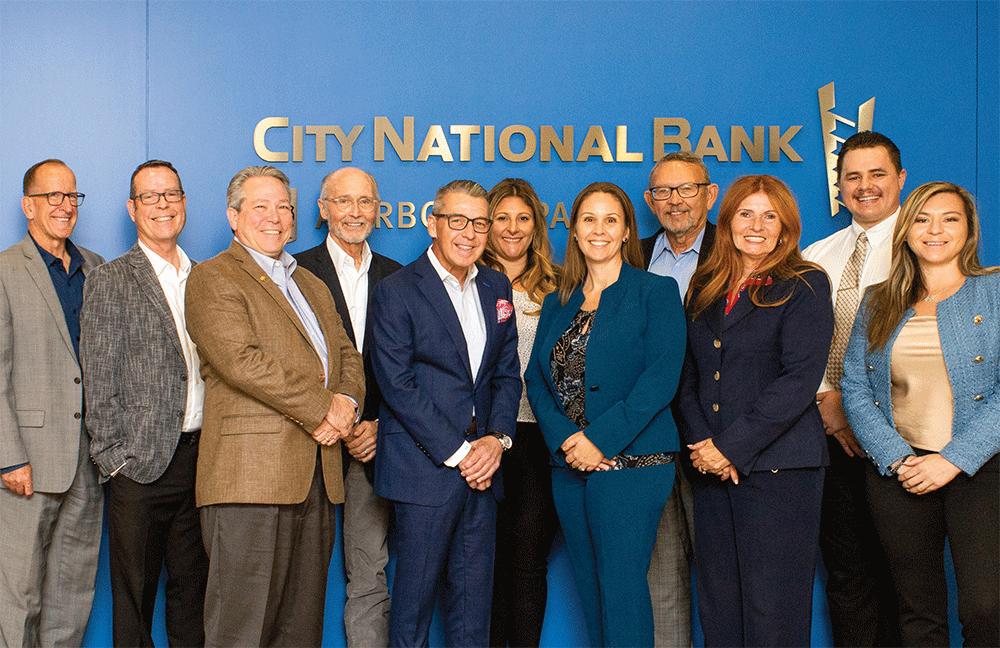
The public accounting industry is one under fire. From significant staffing shortages, constant changes in legislation and a lack of support from the Internal Revenue Service (IRS), a career in accounting is not for the faint of heart. Recently, CPA executives met at a roundtable to discuss the many challenges they face as an industry and the solutions they have implemented to overcome them. This roundtable was sponsored by City National Bank and held in Las Vegas.
Connie Brennan, publisher and CEO of Nevada Business Magazine, served as moderator for the event. These monthly roundtables bring together different industries to discuss issues and solutions.
What Struggles Do You Face in Recruiting Talent?
Mark Rich: Staffing is definitely one of the top five issues in our firm. [The issue extends] from hiring and training up, to retaining, and keeping other firms from approaching our staff. Just yesterday we had a call from a managing partner of a firm who cold called a staff person [on our team] that never met them and just saw them on social media. It’s that desperate right now.
Chris Wilcox: Our biggest challenge is staffing and that creates the second biggest challenge, which is being able to provide some kind of work/life balance for our people. I look at the hours that people are working and I am just praying that I can figure out a way to make them happy because they are getting approached.
Daniel Gerety: We have California firms that have stolen some of our people, saying, “You can live in Las Vegas, and we will pay you Bay Area wages.” We are competing with LA and San Francisco for staff. The real challenge is, how do we make it the right environment? People want to work less, so how do we fit all of that in and still get the work out and bill it correctly so that our clients can afford it?
Jacqueline Matthew: Finding administrators that are used to working in a professional services environment and showing up with the acumen, speed and ability to function can be tricky too. We’ve taken to hiring from more non-traditional type pools. We have had some success with that.
Mark Bailey: The problem [of recruiting talent] has been exacerbated dramatically by the fact that we have a workforce that doesn’t want to work 70-hour weeks. We have essentially shot ourselves in the foot with increased disclosure requirements and much more complex accounting rules. It is exacerbated by the fact that these young people can go out and get a better job and work 40 or 50 hours a week for private industry. We are not just competing with CPA firms; we are competing with private industry on a big time standard.
Matthew: I find the biggest challenge has to do with certainty and how that impacts your culture. We are getting desperate with staffing and we don’t have enough people. They want this and they want that, and I think that there’s kind of a knee jerk [reaction] where we want to accommodate that. We want our people to be happy and to have what they want to have. But at the same time, there is a firm culture that has to be maintained. How far are we as leaders willing to stretch to accommodate that and or to potentially shift our culture? That is a big question. If you are not certain of your culture, how do you possibly find the right fit if you don’t know what that actually is?
Bryan Keller: The model used to be that you had to pay your dues in public accounting. It did not matter what size firm. Basically, you made no money for about ten years. [But in] the last two years it’s like we changed our interest. Last fall, we had to change our entry level [salary] in the middle of recruiting season three times. I had never seen that before. It is a challenge and [we are] competing with everybody, but especially here in Vegas. Somebody that any of our firms could hire could have made more money as a bartender or waitress on the Strip than they could as an entry level accountant.
Alisha McClellan: [Starting salaries] have gone up more in the past two years than they have in the past probably 20 years combined. They moved really, really slow, which I think is a huge factor in the shortage of graduation rates. And now they have shot up dramatically.
Gerety: Students now, instead of going through an accounting degree which is very difficult, can get a marketing degree and come out of college and get paid more than what a starting accountant gets paid. And so, our starting salaries will have to go up, which means our fees will have to go up.
Matthew: The trick, particularly in the state of Nevada and other states, is the 150 minimum credit hour [requirement]. That ends up being a barrier because these kids get an accounting degree and they don’t want to take the exam. It is not quite that simple because they need to go another year and obtain a master’s degree or the equivalency. That is a real barrier for entrance into the profession. Not to mention that it is not the sexiest profession [with] 60 to 70 hours work weeks. That is just not really appealing to those coming out of school right now.
Has Technology Influenced the Interpersonal Aspect of Accounting?
Keller: In our profession, we have put such an emphasis on being efficient and fast with technology, and so it is easy for [the younger generation of accountants] to get lost in their laptops. It is a different experience.
Curt Anderson: We have trouble getting people to pick up the phone and call the client. [They say], “I want to email them. I want to text” and we don’t do that. We really discourage text. But [people insist] “I want to email because it is easy for me.” But what about the client relationship? That is a hard one to change.
Rich: As far as the gap goes in generation, [some of the staff have] dated online and that is how they do everything. They buy everything online and when you are dating online, you don’t have that face-to-face communication. The expectation of our firm is that you are able to communicate with clients on the phone, but they are used to prepared text, emails and FaceTime.
Matthew: I think face-to-face [meetings] or phone calls and hearing someone’s voice and laughter and being able to have a conversation [adds a] different layer [of communication] than from Zoom or something like that. I think we are all Zoomed out. What is most important is that we are teaching those who are coming to work with us how to form relationships and to meet clients where they are at.
Keller: We have had a roomful of auditors working, and the CFO was right down the hall and [yet] they are emailing questions instead of walking down the hall [to ask their questions]. We would have never done that. They are just trying to be efficient and fast.
Matthew: [Meetings don’t] always have to be in person, maybe someone prefers Zoom. But understanding [the difference] and teaching our staff how to develop those relationships in whatever way meets our client’s needs and giving them the tools needed to do that [is important]. Quite honestly, I think sometimes the younger generation may not have [the tools they need] because of the way they communicate. They may not know how to sit down and say hello to you and look you in the eye. Growing up, that was kind of expected of me.
Rich: I think that is where technology hurts us, because we are not sitting down face-to-face like we need to because it is convenient to use technology versus face-to-face. There is a big difference. It is dangerous to do business through email, Zoom and things like that. You are going to lose your client to someone who meets face-to-face. That is where we need to be proactive.
Zachary Tompkins: I think [there is also a] challenge in the training of remote employees. You can [use] Microsoft Teams or Zoom to try to get the best [training] you can, but when they are sitting in a different state, it is difficult.
How Has COVID Impacted CPAs?
McClellan: For all of our practices we have had to become specialists in COVID incentives and consulting overnight. And while most of it is great, it does bring up a lot of problems. Some of the [the problems include] the rules, guidance and regulations [that] did not come out at the same time. They are still coming out and still developing. We are now seeing many clients who received benefits from employee retention tax credits that are getting challenged [and there are] audits and different things like that. I think we are going to see as a profession, in the next couple of years, enforcement and legislation related to that.
Matthew: Since COVID, federal compliance is through the roof. I feel like every audit I touch is a single audit, [a] program specific audit, [and] things like that that are very specialized for these government programs. Some of these federal granting agencies are behind as well. Millions and millions of dollars were given out very willy nilly to nonprofits and for profits alike through COVID with the rules coming afterwards. It has definitely presented a lot of challenges. We have seen a huge uptick in the need for single audits in particular as a result of this funding and there is no end in sight.
Keller: Imagine how much fraud [there will be] three to five years from now between Triple P (Payroll Protection Program) and ERC (Employee Retention Credit). It is going to be massive and that’s going to be a lot of work for us. ERC is already starting to get looked at, which is funny because they are behind on everything else except enforcement. I think we are going to see a tremendous amount of activity from the IRS on those two specifically.
How Does This Industry Stay on Top of New Legislation?
Tompkin: [We utilize] some CPE (continuing professional education) and try to keep up by reading as much as we can. Thompson Reuters is [also] a good help as far as [being a] checkpoint in getting those updates and different things. The IRS has some services that you can subscribe to and get those updates and that has been helpful to see what is coming out. It is pretty much every morning, if not weekly, that something is coming through and you are having to keep up with it.
Bailey: You cannot be all things to all people anymore. If you are in tax, you better specialize [or] have somebody that specializes, otherwise you are going to get in deep trouble. It is the same thing with auditing and accounting. The standards change so regularly and then we try to do consulting on top of that and that is why we are up late at night and working the hours we are working.
Wilcox: The rules that we deal with, whether it is audit or tax, are so complicated that we can’t do it all. We have to specialize which was a big driver for why I merged my firm. Our clients were getting bigger and we were running into issues that I couldn’t handle; I needed that next tier of support. I think we are going to see that more and more in this profession.
Anderson: What you are seeing too with the maturation of all our client bases is that we are multi-state now [because] clients are multi-state. The issue [with] these different states is how to treat these kinds of transactions. Do I have sales tax issues? Do I have income tax issues? I had a law firm who wanted to hire a remote worker in California. Well, you have got all sorts of things [you have to consider in order to do that]. You have got to be a California employer. You get worried about your benefits because you can’t use Nevada insurance in California. Then you have got the California tax issues that come up with it. It’s just nuts. These multi-state issues are becoming more and more of a drain, technically, than even some of the federal stuff. They [are a drain] for business as a whole, not just [individual] businesses.
How Have Problems at the Internal Revenue Service Affected CPAs?
Gerety: They are so far understaffed. People are waiting for refunds for nine months. You get an amended return, and we are still getting notices to levy on stuff that is already fixed, but they have not processed it yet. It is terrible. It is the worst it has ever been with the IRS. They need more staff. They are so far behind. They still have some computers using five and a quarter inch floppy disks on the doc system.
Rich: The types of issues that we are dealing with every day are annoying correspondences that we know are wrong. There is no response other than saying they plan to respond. If you send a correspondence [to the IRS], a month later [you receive a response saying], “we are working on it,” but there is no resolution. That doesn’t help us at all as professionals.
Bailey: They are not answering the phones. If we have powers of attorney and we have to call the IRS, I usually hand it to a staff person or an administrative person and [have them] wait on the phone for two hours.
Tompkins: Every time we call in, we try to get three accounts done at the same time just so that we are being efficient. We had one amended return that sat in the wrong department for five months. We had been calling and calling, and we couldn’t get through to anyone. We had to get it escalated and they finally responded by saying they needed to move it over to [a different] department and then they would process it. After another eight months went by, we finally saw it on the transcript.
Have Rate Increases Been Difficult for Clients To Understand?
Keller: First of all, we have inflation, and I don’t consider that a fee increase. [There have been] inflationary increases because our costs have evolved going up every year [with] technology, and people and their comp structures, but we haven’t had a lot of pushback. It has forced every firm to look at their client base and ask if we are getting paid fairly for the work that we are doing. And if you are in this profession, you work hard. It doesn’t matter the size of firm you are at, you work really hard and there are great career opportunities. But we have got to be paid fairly. The profession seemed to hold [the same] prices for so long and now for the first time in my career, we have real leverage on fees. And if they don’t want to pay us, there are ten people behind them that want to work with us.
Gerety: We have got more work than we can handle right now. I’m getting calls all the time, asking, “why is my bill this high?” [I tell them to] look at the value they received. We saved them this much money with the planning we did and that has more than paid for [the fees].
Bailey: We have clients that are reluctant to call or to check in with us, and that is why they show up at the end of the year and want everything solved. We have brought a lot of that on ourselves by billing by the hour. [Client’s] attitudes frequently are “I don’t really want to pay him $500 to answer my question about whether I should lease or buy a car.” We have gone completely away from [billing by the hour because of that]. We do keep track of time, but only from a cost accounting standpoint and we try to give our clients an idea or a bid in advance of doing the work.
Wilcox: There are firms who are willing to do work at bargain basement price even in today’s environment. And we, unfortunately, are in a situation where we have to be willing to say that maybe they had better go use that firm because we are going to be burning our people out and we just can’t afford [that].
Anderson: I think we need to do a better job of who we give the best benefit of our services to. There are a lot of ungrateful people out there who think that they are entitled to the best we have to give at whatever the cheapest price anybody else is willing to pay is, and that just doesn’t work. We have to sell benefits, not features, and communicate to clients that it is expensive, but they are getting the attention that they would not necessarily get someplace else. This is the relationship business. It is not a paper business. It is a relationship business. It is an intellectual business.
Keller: You have to be able to show [clients] how you add value. I always tell our people, that even if we are just doing an audit and a tax return, [if] we are not finding a way to add value, then we probably shouldn’t be working with them. There’s a value proposition that goes with working with our firm and it’s going to cost a lot more, but you are going to get a lot of value for it.