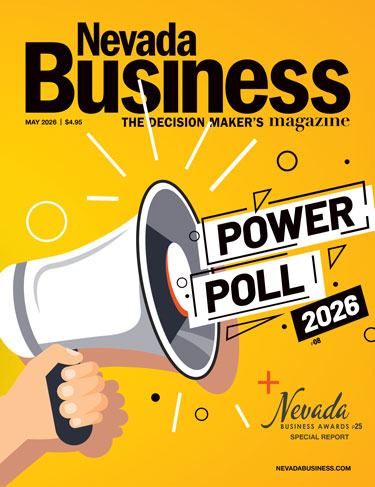
 In February, Nevada Business Magazine sent the 24th Power Poll to decision makers – executives and business owners – across the state of Nevada.
Every January the Nevada Business Magazine cover story explores the possibilities of the upcoming economic year and business landscape in Nevada. The article takes a wide look at economic indicators, talking to economists, experts, executives and business owners working within the economy.
Then, every February for the past 24 years, Nevada Business Magazine has sent Power Poll questionnaires to Nevada business owners and executives. Their work in the diverse industries that make up the Nevada economy puts them directly in the know when it comes to Nevada’s economy and taxes, workforce, business challenges, healthcare, education system, and those social, political and Nevada-centric concerns that hit closest to home.
The January economic forecast feature explores what could be based on what has been, high level predictions mapping the year ahead. The May Power Poll outlines the reality from those business owners and executives living and working inside those industries.
The 2026 Power Poll respondents were a mix of owners and executives. Of the respondents, 61% identified as business owners, and 39% identified as executives. Those numbers track with previous years; In 2025, 65% of the respondents were business owners and 35% identified as executives. In 2025, 69% had businesses located in Southern Nevada, 28% in Northern Nevada, and 3% were rural. In 2026, 72% had businesses with a primary location in Southern Nevada, 25% in Northern Nevada, and 3% in rural locations. Of those responding, 22 percent had offices statewide.
Nevada Means Business
By the numbers, 62% of respondents have been doing business in Nevada for 20 years or longer. Only 4% have been in business less than five years, an increase of 1% since last year’s poll.
Respondents from last year’s poll overwhelmingly (88%) believed Nevada is a business friendly state. However less than half (48%) of this year’s respondents believe our state is friendly to business.
One respondent said that while Nevada has low business taxes and no state income tax, it’s hard to find quality vendors and the lack of diversity in business industries makes it difficult to get non-casino clients.
Those who found Nevada to be a good place for their business referred to the business climate and opportunities for growth, and pointed to the quality of life as being helpful in their acquisition of talent. One said Nevada is strategically located in the firm’s western region footprint. Others mentioned doing business with other companies located in Nevada.
Gary Bordman, CEO and founder of Amusement, Exhibit & Event Services, indicated that Las Vegas is the perfect place for a trade show company, which does events nationwide from its Southern Nevada location.
According to Troy Reierson, Berkshire Hathaway HomeServices, “Las Vegas has momentum, opportunity, and adaptability.” Continued inbound migration into Southern Nevada is a key driver for the business, fueling consistent demand and creating opportunities for businesses positioned to serve residents. Because it’s an evolving market, Southern Nevada isn’t constrained by rigid structures, Reierson said. “Growth in new construction, luxury housing, and investment segments continues to reshape the landscape, allowing room for innovation and forward-thinking organizations.”
For Michael E. Minden Jewelers, being located in Las Vegas means doing business with customers from around the world—athletes, celebrities, movie stars and music icons.
Kevin Murphy, president, Murphy Jones APC, cited Nevada as a great location for their law firm because it combines entrepreneurial energy with business growth and a relationship-driven community.
Ali Nairizi, president, Reno Tahoe Pain Associates and United Pain Urgent Care indicated it’s easier to run a small, independent medical business in Nevada than in other states where private equity is buying up practices.
According to Brian Cushard, CEO, LP Insurance Services, Nevada’s business-friendly environment is the key advantage. Citing no state corporate tax, no income tax, no franchise tax and no inventory task, the company can invest more resources in serving clients and growing the team. Easy access to western states supports diverse industries the company insures, from gaming to logistics to agriculture.
The Business Environment— Economy and Taxes
Last year started off with an uncertain national economy and a corresponding unsettled Nevada economy. That trend continues into 2026 with the cost of groceries and gas skyrocketing, tariffs driving up prices, and the war in the Middle East creating uncertainty.
“We are more divided as a state and nation more than any time in my life,” said Mark Bailey, managing partner, Excelsis Accounting Group. “The tariffs are an additional burden paid by our citizens—not by importing countries. This is having an adverse impact on us economically. The lack of confidence in our federal government by both our citizens and other countries diminishes respect and creates economic uncertainty.”
Bringing considerations of economics closer to home, respondents were asked if they believed that, compared to 2025, their business was doing better or worse. They were additionally asked the same question of the state’s economy. Those questions were followed with a crystal ball prediction of what they expected for their businesses and the state in 2027.
Results were mixed. Business owners and executives mostly felt that their business’s bottom line in 2026 was somewhat better than before (29%), about the same (33%), or somewhat worse (19%), with only 3% stating their business was much worse than before, and 16% stated it was much better.
Regarding the state economy, 21% responded it was better or somewhat better than before, 46% that it was about the same, and 30% that it was somewhat worse. Only 3% felt it was much worse.
Looking ahead, 21% of respondents believe their business will be much better off in 2027, 35% believe it will be somewhat better and 38% that it will be about the same. Only 5% expect it will be somewhat worse, and 1% said it will be much worse. Numbers are equally concentrated in the middle for the state’s economy – 6% believe it will be much better off, and none of those responding indicated they thought it would be much worse; 43% feel it will be about the same.
Where there’s an economy, there’s taxes. Where there’s industry, there’s taxes. That said, Nevada has long been considered a business friendly state, and part of that image is the lack of income tax. If proposed, only 8% of respondents would support an income tax in Nevada.
That said, Nevadans still feel there’s too much of a tax burden in the state.
“Unequivocally, yes,” said Keith Pickard, founding partner, Nevada Family Law Group about tax burden on Nevada businesses. “We spend so much on unnecessary things simply because the majority wants to garner support in the elections or pass it on to their base. It’s the same disease we see in Washington. I think we’d be better off letting private businesses do more of the heavy lifting and government should get out of the way.”
Pickard wouldn’t support an income tax in Nevada. “That would be a monumental mistake for a lot of different reasons, but I think that would really hurt. We’re taking money from the people who can least afford it by doing that.”
Larry Monkarsh, managing member of LM Construction Co. wouldn’t support income tax in Nevada, either. “It keeps us ahead of the game. It keeps us competitive,” he said of the lack of an income tax in the state. “I think there are other ways to make money than reversing decades of good will. We got people here by not having one.”
Even as Nevada’s economy diversifies, gaming and mining remain mainstays, and continue to be vital for Nevada’s economy. The majority of responses indicate Nevada business owners and executives believe both the gaming industry and the mining industry are paying their “fair share” of taxes.
Doing Business—Workforce and Staffing
Business keeps the economy going. People keep businesses going. Business owners and executives cited finding quality employees as their primary business workforce challenge, more than any other hurdle, followed by concerns over benefits, turnover and retention, among others.
The majority of respondents (92%) believe workforce development is critical for Nevada business. There’s a need for a skilled workforce to support industry. Nearly half (42%) of respondents have increased their staffing needs in the last 12 months, and 58% expect to do so in the next year. Only 13% have reduced staff; with 5% expecting to have a smaller staff next year.
“Workforce development is highly important,” said Monkarsh. “It’s a driving factor in our economy. We’ve got good skilled labor that can do the work necessary to build these facilities. Without that quality labor workforce it’s tough to staff projects and get them done on schedule.”
Workforce development is also critical because it’s not just about finding jobs, Pickard said. It’s diversifying the workplace and trying to bring in new industries to Nevada. “And they’re not coming largely because our education system is in such poor shape.”
Workforce development is also important because the state has lost so much skilled labor in the wake of immigration crackdowns.
Respondents are more split on unions, with 37% agreeing unions are necessary and the remaining 63% stating the opposite.
Business Challenges
Access to capital and financing isn’t seen as a huge hurdle by respondents—only a handful stated they were very concerned about access; 20% stated they weren’t concerned at all.
“[In regard to] access to capital, we have no concerns. We’re a bank owned by a large parent,” said Bruce Ford, SVP, regional banking manager, City National Bank. “Inflation, though—it’s higher than any of us would like. It’s a concern for our clients who tell me how it impacts them, especially those who import items.”
Business owners and executives are more concerned with inflation and operational costs. “Oil is a big thing right now,” said Monkarsh. “We’re concerned about everything that contains oil-based petroleum product. Operationally, rents are high. Our rates, our bills are high. So we’re constantly looking at our operational costs to keep them under control.”
Facts of Life – Healthcare and Education
Despite challenges facing businesses, Nevada is a popular state for businesses to locate. Between the climate, access to 11 Western states, lack of corporate and income taxes, the state offers a lot to businesses.
When it comes to healthcare and education, though, there’s room for improvement. Asked to grade healthcare in Nevada, only 3% gave it an A, and 15% a B. Most ranked it in the middle, with 46% of respondents giving Nevada healthcare a C, 22% a D, and the last handful (14%) giving Nevada’s healthcare an F. The majority are very concerned with healthcare costs and access, for their employees and their own families. Only 3% stated they weren’t concerned about cost, 10% were unconcerned about quality and 19% were unconcerned about access.
Nevada’s public education system didn’t receive a stellar report card, either. Only 1% ranked it an A, 19% graded it F, and the majority, 38%, gave it a D. Ford graded Nevada education a B, feeling local school district leaders are doing as good as job as they can with the resources they have.
Concerns with education focus on accountability, funding, parental involvement, reform, school choice and teacher salaries. Pickard gave Nevada education an F, pointing out it’s a deterrent to businesses that might want to locate here. “We’ve eliminated accountability in the system. We have kids failing to gain an education, but they’re advanced anyway. We see so much money going into the system,” he said adding, “and we’re still in last place.”
“Parental involvement is key,” said Ford. He has two school-age children and has seen that when parents are involved with their kids’ education, those students thrive.
Elected Leadership
Federal and state governments both impact Nevada businesses. The Federal government has been moving at a frantic pace throughout 2025 and into 2026; costs of everything are rising, tariffs and the war in the Middle East has an effect on the costs of doing business.
Asked to rate Nevada’s federal representatives on a scale of excellent, above average, average, below average, poor and no opinion, both Democratic Senators Catherine Cortez-Masto and Jacky Rosen got ratings across the board, with the highest concentration of responses as average. Rep. Dina Titus (D) fell into the poor category, Rep. Mark Amodei [R] into average, as did Rep. Susie Lee (D) and Steven Horsford (D).
President Trump received a C-, which matches his ranking from last year. Responses regarding the impact of the Trump administration on Nevada were varied.
The general consensus, according to remarks on the poll, seems to be tariffs and policies have stalled the economy, increased inflation and decreased tourism, particularly from Canada. The slowdown of tourism has a direct impact on Nevada and global tourism is way down as Canadians and other foreign travelers avoid US travel.
The Iran war has driven up the price of fuel to historic levels to match the unprecedented rise in the cost of groceries.
Other executives approve of the Trump administration. Matt Kershaw, president and CEO, Create Credit Union, saw a positive in the resurgence of domestically mined and processed rare earth minerals.
Changes in public land policies for Nevada have created new economic opportunities, even while raising environmental concerns, said Trisha Litzau, director client development & marketing, Gensler.
On the home front, for Nevada’s state-level politicians, Gov. Joe Lombardo [R] received a B, the highest grade for any elected officials on this poll.
“Governor Lombardo has done an excellent job navigating those choppy waters with our current administration in Washington,” said Monkarsh. “I’m happy to see that Nevada stayed out of the cross hairs in that sense.”
Nevada’s metro area mayors, Shelley Berkley (Las Vegas), Pamela Goynes-Brown (North Las Vegas), Michelle Romero (Henderson) and Hillary Schieve (Reno) were all ranked average.
“Shelley Berkley is doing a fantastic job for the City of Las Vegas, and Pam Goynes-Brown is doing a fantastic job for North Las Vegas,” said Ford.
Close to Home
Executives exhibited more concern over state issues like water, homelessness, gun control and immigration than elected officials, as the category with the most responses for both federal and state elected officials was no opinion.
When it comes to the actual voting for those elected officials, nearly all (83%) of the Nevada executives responding believe there should be term limits for all elected officials. They also favor requiring ID in order to vote, 79%.
Should judges be elected or appointed or a combination of both? Nevada executives mostly agreed on a combination of both methods for putting judges on the bench.
The majority of Nevada executives and business owners are very concerned (50%) or somewhat concerned (39%) about homelessness in the state.
Water is a critical issue for Nevada. “Because if we can’t get sustainable agreement for the Colorado River, we’re all going to be moving away because there’s not going to be water,” said Pickard.
Gun control was pretty evenly split among respondents; 26% are very concerned about the topic, 36% somewhat concerned, 27% not very concerned and 11% not concerned at all. “I live in an open carry state and I chose to live here, so I’m fine with it,” said Ford.
Moving Forward
“There’s still an opportunity to save this year,” Monkarsh said. “The first quarter started off much better than last year’s first quarter. Hopefully it continues that way. I believe it will. Even when there’s wars and people stop traveling internationally, Vegas still tends to do well.”
Nevada as a whole seems to be navigating the uncertain journey 2026 is proving to be with solid steps in the right direction.
The market is still vibrant, Ford said. Businesses are hiring. Some executives feel once the war is resolved and geopolitical issues settled, 2026 will course correct and Nevada businesses and leaders can focus on issues within the state as much as dealing with forces from the outside.
As one executive said about Nevada being the right place for their business: It’s growing, it’s tax friendly, and it’s home.