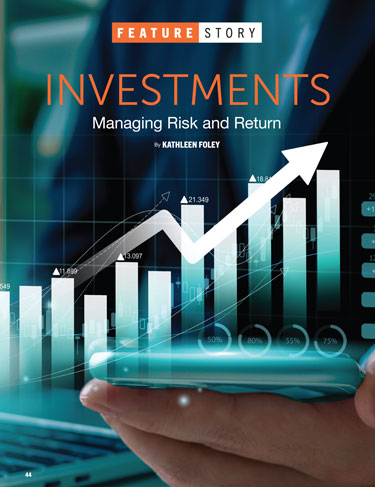
 Visiting a financial advisor in the 20th century typically meant choosing which stocks and bonds to put in your portfolio. Investments today range from these traditional vehicles to real estate, private equity, precious metals, and even Bitcoins and NFTs (Non-Fungible Tokens). Since each option carries its own risks and rewards, financial advisors must be familiar with a wide range of investment opportunities.
“Stocks are a growth engine, but investors must be able to weather volatility and bear markets,” said Brian Loy, managing director of the Reno office of Wealthspire, a national company with more than $580 billion in assets under management or advisement. “Just about every two years, the market is going to fall 10 percent, and about every six years it’s likely to have a 25 percent decline,” he explained. “You have to hang in there when your wealth seems to temporarily disappear. Bonds are great because they can add income and ballast, but they face interest rate risk.” Simply put, when interest rates rise, new bonds with higher yields become more attractive, lowering the market value of older, lower-yielding bonds.
“The most popular investment choices in the last three to five years have been what the financial services industry refers to as alternatives,” said Randy Garcia, founder and CEO of The Investment Counsel Company, a Las Vegas-based financial advisor serving individuals, families, businesses, and institutions with $3 million or more in investable assets. “Alternatives is a catch-all term for everything other than stocks, bonds, and cash equivalents,” he explained. “Historically, this includes hedge funds, private real estate, and private companies. They are considered alternatives, but not speculative.”
Investors have increased their interest in alternative assets as they seek diversification and ways to manage inflation and risk, according to Paul Johnson, Nevada president for Northern Trust Wealth Management. “Today’s investors are assigning a more strategic role to private markets,” he said. “Since companies are staying private longer, investors are shifting more of their allocations to these markets to capture potential long-term returns. However, outcomes in private markets can vary significantly.” He also said many investors are interested in international markets due to more attractive valuations, though these markets remain sensitive to geopolitical risks and energy price volatility.
Johnson also noted that during periods of uncertainty—especially when concerns about inflation or currency stability arise—many investors turn to precious metals, primarily as portfolio diversifiers rather than primary return drivers. “Precious metals can be a potential hedge for downturns,” said Loy. “But they have challenges: they don’t produce income, they’re cyclical, and they require storage.”
Garcia warned, “The rate of return [for precious metals] is less consistent than the other major asset classes like stocks, bonds, and real estate. If you buy wrong, you may have to wait decades and decades to break even, let alone make money. So, the timing is more important in precious metals than in the time-proven asset classes.”
Real estate has always been a popular investment, but today’s market conditions and interest rate environment make it less lucrative than in the past. “The great thing about real estate is that it can generally provide both income and growth,” said Loy. “But, because they’re big investments, that often means either concentration or leverage, and right now interest rates have come back up, so real estate investments are more expensive than before.”
Garcia explained that the pandemic altered the supply-demand balance for commercial real estate. With fewer people working full-time in offices, demand for office space dropped. People developed the habit of buying online, which affected both retail and industrial. “Apartment complexes got overbuilt during Covid, so they don’t have any pricing power right now,” he said. “If you can’t raise rates while your expenses are increasing, then your property value isn’t going up. So, real estate does not seem like a wonderful thing to invest in right now. It’s been flat on average for the last year-and-a-half or two years.”
Higher interest rates also reduce real estate’s attractiveness to investors. “Real estate needs interest rates to drop without a weakening economy, which would reduce demand,” said Garcia. “We need a combination of lower rates and a stable, stronger economy to help real estate recover.”
Digital assets like Bitcoin and NFTs may seem attractive for the high rate of return they advertise, but caution is warranted, according to Loy. “Those kinds of investments offer high potential, but with extreme volatility and uncertainty,” he said. “Trying to size the investment and the time horizon is really critical.”
Garcia goes even further in warning investors about digital assets. “I have a problem with people who say Bitcoin, NFTs and the like are investments,” he said. “The concern I have is that the younger generation thinks they are investing when they are actually gambling, and they fail to understand the difference. Nobody said you can’t make money gambling. I’ll be the first to admit that, but let’s not confuse the two. And if you look at the data, it validates that these things are gambling, to a large degree.”
Testing the Waters
Stocks, bonds, real estate, Bitcoin, gold and silver – so many options are available. Each has its own pluses and minuses. Savvy investors often try to reduce risk by balancing their portfolios with both short-term and longer-term investments, and low-risk and more aggressive products. Garcia said people wanting to invest heavily in stock from a particular company or industry are risking losses in case of a downturn that affects that company or industry. “There are three types of risk,” he explained. “There’s economic risk – what’s happening in the world – there’s industry risk, and you have risk specific to any one company. Warren Buffett would advise you to diversify, not only in companies, but also in industries.”
Discussing alternative investments, Loy said, “A good rule of thumb I’ve used is, when you want to diversify into a different kind of investment, limit it to 5 or 10 percent of your portfolio, because it may be extremely volatile. But let’s just say you needed a 6 or 7 percent rate of return long-term to reach your goals. It’s like bath water. You have hot water – things that are going to generate much higher returns, but have a lot of risk. And you have cool water, things that are more conservative. When you put cold water and hot water together correctly, you get the temperature just right.”
Protecting Investors
Faced with an uncertain geopolitical situation, interest rate concerns, and worry about what’s next for the U.S. economy, the average investor often turns to a trusted financial advisor for insights and direction. “There’s a lot of uncertainty – whether it’s war, politics, inflation – the natural reaction is fear and paralysis, or trying to chase whatever’s a sure thing’” said Loy. “But my view is that uncertainty is normal. It’s not new. We just remind people that the stuff we’re seeing now isn’t what will cause the next big downturn in the market. It’s going to come from somewhere out of left field. So, how do you prepare for that? And that’s the job of good financial advisors.”
Johnson said recent volatility highlights the importance of strong underwriting and careful manager selection. “Periods like this often widen the gap between top-performing managers and others,” he said.
How can an investor be sure that the person they trust with their nest egg has the knowledge and experience to make good decisions? “If I had one cautionary piece of advice to give an inexperienced investor, it would be, before you trust an investment advisor, ask their level of education, experience, and specifically the hours of continuing education that they put in every year,” said Garcia. “And then lastly, everybody should check with the regulatory compliance government entities to make sure that these advisors have not had compliance violations.”
Referrals from friends or colleagues can help you find an advisor who’s a good fit for you, according to Francisco Aguilar, Nevada Secretary of State. “You want to know who they are, how they got to where they are, and what licensing and training they have had to give them the expertise you need,” he said.
“Ensuring your securities professional is licensed is a critical step to protecting yourself and your investments,” advised Aguilar. Individuals and companies are required to be licensed in the State of Nevada if they conduct securities business in or from the state. Licensees are subject to regulation by various agencies, and their disciplinary records are public information. “You want to make sure you’re dealing with a licensed broker-dealer or investment advisor or a licensed firm,” said Aguilar. “Make sure, first of all, that the person has the proper regulatory documentation. If they don’t, walk away fast.” Anyone with concerns can go to the Secretary of State’s office or visit the Secretary of State’s website under the Compliance tab.
Another option is to call the SEC (Securities and Exchange Commission) or FINRA (Financial Industry Regulatory Authority) and make sure there are no issues with the company or the investment. Investors can see if there’s something pending, or if there have been complaints against that person already.
“If you feel uncomfortable about a situation, you should step away and call the Secretary of State’s office, because there could be an open investigation on that investment or that individual,” advised Aguilar. “And if that’s the case, you do not want to participate. Even if it’s not an actual crime, if somebody feels uncomfortable, we want to know about it, because it could potentially be something bigger that we haven’t yet heard about. We have a team of sophisticated investigators who are always looking at these types of situations and making sure that people out in the marketplace are doing what’s in the best interest of their clients.”
With the use of technology, scammers can impersonate legitimate financial advisors or use AI to develop online relationships with victims, with the intention of convincing them to invest in a nonexistent project. “If someone is cold-calling you, think twice before you engage,” said Aguilar. “If it sounds too good to be true, don’t do it. And always follow your gut.”
Even if an investor performs their due diligence, there’s always the chance they will be taken advantage of by an unscrupulous company or individual. In those cases, victims can report their experience to the Secretary of State’s office. In calendar year 2025, their office opened 52 civil investigations and 29 criminal investigations.
“The challenge with this is that many people don’t call because they’re embarrassed that they made a bad decision,” said Aguilar. “It’s really hard for us to get victims to understand that it’s okay. We just want to make sure it doesn’t happen to somebody else. If we find out about an illegal scheme that’s going around, we can do a public announcement so the public can watch out for these [fraudsters] or for this particular situation.”
By reporting fraud, victims may also be eligible to recover some of their funds. The 2025 legislative session established the Fund for the Compensation of Victims of Securities Fraud to provide financial assistance to victims of securities violations. People can apply for compensation by filling out a form available from the Secretary of State’s Securities Division. Aguilar noted that, although the fund was established, it wasn’t fully funded, so his office is working on a way to build up the fund. “We may not be able to replace everything [a victim] has lost, but at least we can give them something,” he said.
Despite the risks inherent in any investment, Aguilar said Nevadans shouldn’t shy away from investment. “Investments make our economy work,” he said. “They drive entrepreneurship. We need investment to happen. Right now, especially when the economy is tough, the right people are looking for opportunities to go forward.”