Professionals working in Nevada’s commercial real estate industry are being challenged on all sides. While many of these challenges are not necessarily new, others are projected to impact the industry long-term. Technology is changing the way business is done by creating more efficiencies. While this is surely positive news for an industry that is often encumbered by lengthy contracts, AI and automation are opening the door to new client demands.
Despite these challenges, the experts are focused on training the next generation of commercial real estate brokers.
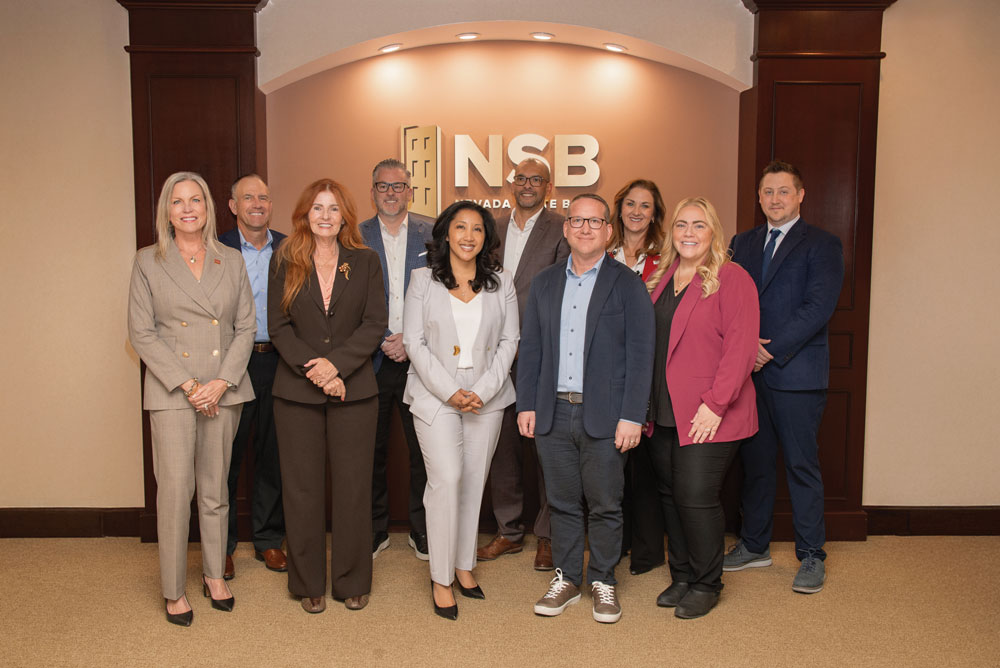
Recently a group of brokers in commercial real estate met at a roundtable sponsored by Nevada State Bank to discuss their industry. Connie Brennan, publisher and CEO of Nevada Business Magazine, served as moderator for the event. These monthly roundtables bring together different industries to discuss issues and solutions.
What Role Does AI Play in This Industry?
Venessa McEvoy: One challenge with brokers that are early in their careers is that they depend on AI like it is the Encyclopedia Britannica. They depend on it for market knowledge versus working for it the way a broker who started maybe 20 or 30 years ago would, which was to walk the street, drive the market and figure it out manually. Short-term that sounds like a very difficult and impossible thing to do, but long-term, it increases your market knowledge in a way that no one can take away from you. No one can deny what you saw with your own eyes.
Jeff Jacobs: AI is a huge efficiency tool. And the brokers that embrace AI are going to be able to do more transactions than the brokers that do not. You are going to have to adapt and incorporate it into your business or you are going to get left behind. That is really what it is. I do not see it replacing brokers altogether.
McEvoy: It is a tool and a resource. I am not a big AI user in comparison to some other people, but the more I use it, the more I use it. There is a way to utilize it and get power out of it, and then there is a way to damage yourself by depending on it in such a way as to remove yourself from what the market is actually telling you.
Jacobs: If you try to manage your brokerage without the internet or you do not use a computer to do math calculations, you get no points for creating difficulty. We have an efficiency tool [in AI] and we expect everyone to be using it.
Steve Neiger: I am probably most excited about it for the entrepreneurs and the boutique brokers because the number of things that you can do now with it [is impressive]. From lease review to marketing, there are many tasks that used to require 5 to 10 people, but now you have a zero-cost, know-it-all personal assistant that can help you within seconds.
Cassie Catania Hsu: The reality is that in commercial, our deals are typically more complex than residential. Where we can lean into AI as an industry is to increase efficiency. It will impact speed to market. For example, we are seeing it used within marketing. I have seen applications of AI technology where you can remove clouds out of the sky in a photo. Uses like that will increase efficiency and speed to market and it will be beneficial. I do not think it will be all-encompassing for us in our industry, but if you find ways to utilize it that help and make you more efficient in your business, it will be a great tool.
Suzette LaGrange: And it is never going to replace the relationships [we have with clients]. Whether it is the broker across the table from you or the landlord that you know because you have already done three to six other deals with, AI is not going to tell you who that person is.
McEvoy: Having our brokers use AI so that they can spend more time on relationships is the best way they can use it. I would not expect AI to directly impact the way that they have relationships or the trust built with their clients. AI will provide them with an opportunity to complete administrative tasks more quickly so that they can focus on those relationships.
Neiger: People like doing deals with people, and I do not know if that is going to change anytime soon. That is our entire business. It is about trust and judgment. You can take what AI gives you, but you have to use your judgment.
LaGrange: You still need to interpret what AI gives you.
Chris Jackson: I have seen AI create errors. We have run leases and numbers through it and were pretty surprised to see errors in it. I am optimistic about AI, but cautiously optimistic. We have to be careful with it.
Neiger: That is where the judgment comes in. You can’t trust it, but it can save a lot of time. It can give you the direction, but you have to go back and decide if that was an accurate statement or not and whether you need to take further action with an attorney.
Karen Thomas: Our industry is changing, and we need to go with what is happening with AI and realize how it can help us because those that will succeed will be using AI.
Cameron Glinton: It is definitely not going away, but I do not see it disrupting the industry like it will with some others. People will continue to use it as a tool, but the average transaction is pretty complex. Understanding the private client’s needs takes more than a machine. It comes back to relationships. AI is not going anywhere, but I do not see it replacing agents.
Jacobs: No, but it is going to impact our business in other ways. We are seeing it right now in the office market. Call centers, for example, are not going to exist. They are already starting to not exist because they are easy to automate. It is already creating vacancy in the office market and combined with fallout from work from home, it has made lenders hesitant to lend on office, which makes investors hesitant to invest in multi-tenant office. We are seeing that impact and it is already greatly disrupting our industry.
Catania Hsu: Data centers are going to be probably the next wave, and I am not sure we know how to handle that because you need land and you need power.
McEvoy: And on the industrial side too [we are seeing an impact]. How we use AI to create better efficiencies within the warehouse is a question that we are not anywhere near understanding the answer to, but some are attempting it. At a conference I recently attended, one speaker said we need [more spaces] with a 42-foot clear height. I immediately thought that I know of one building here that has a 42-foot clear height and in Reno there are not any at all. I wonder what industrial developers will do moving forward.
Glinton: [There is interest from clients] across the board. We have seen a big surge in multifamily, retail, industrial, and office. There are deals on all products on the investment side.
Catania Hsu: Our debt structured finance mortgage broker in our office says that he sees all property types in play more than 18 months prior. It is not just industrial and multifamily now. There is an opening across all product types. He is also seeing more lenders that are coming to the table willing to invest across product types.
Glinton: We have a lot of clients that are moving off the sidelines. They are looking at now as a great time to lock in debt or look at deals that are cash flowing, whereas before most deals just did not pencil.
Jackson: We also still have a good number of owners in the valley that bought in the downturn. They got in at a good price and since then rents have doubled, so cash flow is good and occupancy is high. There is not a lot of motivation to sell. Oftentimes the question becomes, what can I trade into?
Jacobs: We are continually being asked by out-of-state investors about what is going on in Vegas. They mention reading the New York Times article about visitor volume being down almost 8%. They are hesitant to chase the market or enter the market because of the headlines. We need to convey the story that we have over $30 billion of capital projects underway. The town is growing by almost 2% every year, year-over-year. We have an amazing growth story. And when we pull back and look at 8% visitor volume off of historic highs, it does not mean the sky is falling. It is an opportunity to place capital in a market that has shown resilience over the years and is continuing to grow.
LaGrange: Industrial in particular is hot, but it depends on where you are as it is very market-specific and product-type-specific. For example, if you are [looking for] a small bay in the southwest, there are hardly any options for you. And they are building on spec. If you need a distribution space at Apex, we are going to wait and let some more space lease up.
Glinton: Locally we do not have a lot of vacancies in office because there was not a lot of office built. We have probably one of the lowest vacancies of any major metro. We are in the top 10 for lowest amount of vacancies as a market. I do not know if there is a flood of investors moving into office at the moment even though there have been quite a few deals that have been on market with a pretty long list to close. But there is still a strong demand for small bay industrial, multifamily if the inventory is available, and retail continues to be strong.
Jacobs: Anything in the southwest in any product type is desirable. But the office market is almost full in the southwest beltway. Meanwhile central Vegas tells a totally different story about the office markets. Differentiating between the submarkets is key.
Neiger: There is also office space in the east central market that has been vacant for nearly a decade.
LaGrange: There are buildings that need to be raised and turned into something else. But you can’t always bridge the gap between what the owner thinks it is worth versus what an apartment developer thinks it is worth or is willing to pay.
Glinton: [Multifamily] is typically undersupplied pretty much every year in terms of the number of units that we need based on population growth, and a lot of that has to do with the construction costs and constraints there, which have gone up with tariffs and inflation over the past couple years.
Neiger: There was a period where both industrial and multifamily flooded the market at once. But in a healthy and growing market, that works itself out. That is not necessarily a structural issue. Everybody was building a lot and very quickly, but that does not mean that suddenly everything stopped.
Jacobs: The concern that I have with multifamily is that all the units getting delivered are Class A. The rents there are more than my mortgage. Are the jobs being created going to provide enough to afford these Class A apartments? Because multifamily has a long-term affordability issue that we are not really making much progress on.
Does Land Availability Continue to Be a Hinderance?
LaGrange: Yes, land availability is an issue. Having enough options in the office market and enough available space to provide to your clients for other options has been a challenge.
Neiger: The affordability crisis with housing is driving the land conversation when it comes to Nevada. But people miss the point. You can keep having people move here and building homes for them, but if you are not building the workplaces for them, they have no place to work. That is not working on both sides of the equation. You are providing more housing, but not more places to work so then there are more bodies competing for the same job.
LaGrange: It is a challenge. And it is going to take an act of Congress to change it. But from a political lense, it is unlikely that we can get our surrounding sister states on board to help us, let alone the rest of the country. Nobody wants to help us get more business from California or be more competitive with Arizona or Utah. None of the surrounding states want anything to do with helping us become more competitive. I do not see that happening in my career time.
Neiger: And the cost is correlated because of basic supply and demand. The less land supply you have, the more expensive what is available is, and the opportunists are going to take advantage of that. It is a complicated issue that affects Southern Nevada more than any other place in the country because we are 88-90% owned by the federal government.
LaGrange: We need to get what is inside the SNPLMA (Southern Nevada Public Land Management Act) boundary released and the land that we have to work with and then we need to address the water issue.
Neiger: Getting more land outside of the SNPLMA boundary is an act of Congress issue. There is still a lot of land, but it will literally take an act of Congress which is why it is so difficult. But even for the land within the SNPLMA boundary that was already technically allotted to our county, if you do the math on the federal government and all its agencies and entities, they now own more land than they did in 1998 when the SNPLMA Act was passed. They have been in acquisition mode, and that obviously does not help. There are some administrative things that can be done, and fortunately the county and the governor’s office are leading the charge on some process things that are making a huge difference. But it is complex.
Catania Hsu: The bottom line is that the general population does not understand that Nevada has the highest percentage of government-owned land in the whole United States.
Neiger: In the national conversation, there is a misinformed narrative of the myth which is a vertical only future. Vertical works for a couple use types to a degree, but it is primarily a residential tool, and that makes it even more difficult. Our story is unique. The entire western United States has a public land problem. Gaining national support in DC is an issue that most people do not understand.
What Workforce Challenges Does This Industry Face?
Catania Hsu: Many of us in this room are very involved with UNLV and trying to help build the pipeline. We want to help our teams have solid succession planning and help the real estate students enter the industry.
Thomas: Participating as a mentor with UNLV students is a great experience. If you have not served as a servant leader and as a mentor, I highly recommend that for everybody. Building our commercial real estate community from the ground up is important.
Catania Hsu: I am a servant leader through and through. That is what I do. I am there to help and be at our brokers’ beck and call for anything they may need. As managing directors, we have to bring value and be servant leaders. They have to trust us and know that we are going to support them.
LaGrange: From a brokerage perspective, there are some platforms that are more entrepreneurial and so we are less rigid in how we manage them. We allow those certain brokers to operate the way they need to operate for their business. And then there are others that are not that way. It is a matter of finding the broker that is a right fit for your company based on what you can provide to them in the environment that you have created.
Jacobs: The job of the broker is to be a local market expert. They need to know the players, they need to know the deals, and they need to know what tenants are in the market. And great brokers have a lot of experience. They know everyone, they know everything and they know the history [of the area]. And when the town is growing as fast as Vegas has been over the years, it is not easy for a younger broker to gain all of that experience. And all of that historical knowledge is just incredibly valuable. The town is growing faster than we can gain experienced brokers.
Catania Hsu: We need to be better about helping groom the next generation of leaders. That is why a lot of us help as much as we can with UNLV and do the work to help bridge the gap to get them in the business. I say this all the time, but commercial real estate is the best worst-kept secret. We should be doing more in the community, and well before college. In elementary school, junior high school and high school we should be hearing kids say they want to be commercial real estate brokers. It is not very common, but we need to do a better job of sharing our amazing industry with our youth.
LaGrange: There are also many paths to get into the industry. You may come through as a marketing specialist or from a marketing assistant role like I did after a couple years. Regardless, the most important part is that you have a good mentor to work with day in and day out for a prolonged period of time, such as two to three years, before you are ready to step out and do it on your own.