The mining industry in Nevada is as old as the state itself. However, as the United States seeks to become less dependent on other countries, Nevada’s mining industry has a spotlight shined on it because of how rich the land is in critical minerals. Throughout the world, the Silver State sets the gold standard for mining practices and is leading the charge in creating a mineral independent United States.
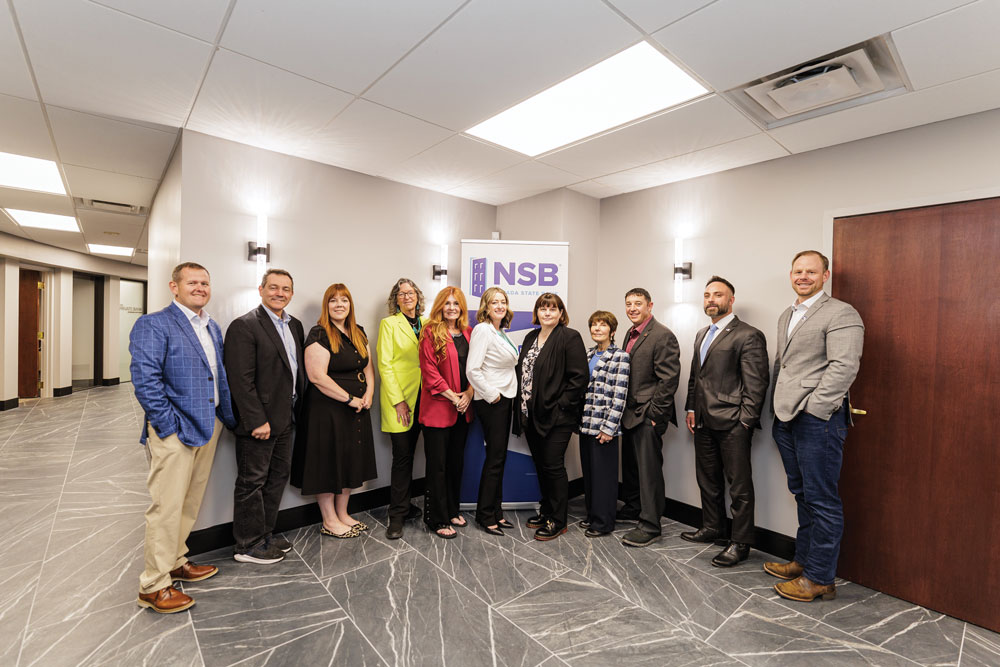
Recently a group of mining experts met at a roundtable sponsored by Nevada State Bank to discuss their industry including its tax contributions, workforce, safety and what is involved in getting a mine online. Connie Brennan, publisher and CEO of Nevada Business Magazine, served as moderator for the event. These monthly roundtables bring together different industries to discuss issues and solutions.
How Important Is Mining in Nevada?
Don Dwyer: It is just as important as doctors and teachers. It is essential.
Rob Ghiglieri: The public is finally aware of the need for minerals, especially critical minerals. However, they do not understand the process and the entire value chain that is needed to be able to sustain domestic development, supply, manufacturing, and the recycling that goes into it.
Corrado De Gasperis: The number one challenge in the state, the country and maybe in the world is power. We need to get more power, and we need these critical minerals to power our devices. We need natural gas, geothermal, solar, and other energy sources because what we are viewing as a data center problem today is going to become a pervasive problem throughout all heavy industries pretty soon.
Debbie Struhsacker: We as a country have a shocking and dangerous reliance on China and other adversaries for many critical minerals. The most recent analysis by the US Geological Survey shows that we import 100% of 16 critical minerals, and we import over 50% of 54 other minerals. That is not for lack of a geologic endowment in minerals in this country. For the last three decades, the country has become more and more reliant on foreign sources of minerals because of a series of complex and unfavorable policy decisions that would displace mining and many other industries and outsource everything. We have traded our self-reliance on minerals for a “just-in-time inventory” philosophy. We found out during COVID that it is a dangerous thing to have your supply chain so fractionated and spread out all over the globe that you end up with shortages of toilet paper.
Nikki Bailey-Lundahl: In the United States, there are only two working refineries.
Struhsacker: China controls about 90% of the processing of most critical minerals. That is terrifying. For example, we mine copper here in Nevada near Ely, Battle Mountain and Yerington. But most of that copper gets exported to Asia (mostly China) and then we import back intermediate products and copper-bearing finished products, from China.
Ghiglieri: The United States annual production of copper would be more than sufficient [for our needs] but we do not even have the ability to process what the scrap would be alone.
Bailey-Lundahl: Our biggest goal is to advocate for the industry and to ensure that through the legislative process we still have the ability to mine in the state of Nevada, because one piece of legislation could hurt the industry to a point where we can no longer exist.
Does This Industry Pay Its Fair Share in Taxes?
Dwyer: We have two specific taxes for mining in the state on top of all the other taxes that we pay that every other industry pays. One of those taxes funds education. We are proud that we can help with education. One of the neat things that our industry has been able to do when the state struggles is to prepay taxes to help. Overall, we do a lot, but it is a dangerous topic because oftentimes there are people that want to look at mining and find ways to come up with more taxes. But that can create issues with our sustainability. The mining industry is definitely willing to pay its fair share. [In fact] we pay more than our fair share, and we want to help create value for our state and for the United States, but it also has to be in a manner that allows the industry to be sustainable going forward.
Bailey-Lundahl: One of our taxes, the gold and silver excise tax, is new and came out of the 2021 legislative session. It is a gross tax. We anticipate with the price of gold going up, that tax will also be going up. We have not seen those numbers yet, but we anticipate it going up, as well as half of the net proceeds of minerals tax that is in our constitution, which directly goes to fund education in the state.
Dwyer: We are number 16 in the state for Gross Domestic Product (GDP), but we are the second highest taxed industry by employee.
Ghiglieri: A lot of people only look at the taxes that are being paid, but every permit in the state of Nevada is fee-funded. None of the regulatory agencies in the state use any of the tax revenue. It is funded by the industry to pay for the revenue to manage the permits. Also, for every lease on federal land, 50% of it goes to the state. That being said, there is additional revenue that is outside of what they are producing and being taxed on production. Their land tenure at the federal level, also comes to the state general education fund. There are multiple ways that Nevada is leveraging the funding from the industry to pay for many things in the state, mainly education.
Struhsacker: An important, but underappreciated aspect of the taxation system for mining in this state is that when commodity prices are high, both the industry and the state go to the bank together. And when gold prices are as high as they are right now, there is going to be an enormous tax payment, especially the gold and silver excise tax. And that is terrific. We all benefit from that elevated commodity price. But on the downside, you want to make sure that your taxation system is not such a one-size-fits-all rigid system that it forces projects to have to close because they can’t afford to pay the taxes. It is good that it is tied very fundamentally to the commodity prices.
Ryan Snow: We are at $4,700 for gold today and everything is great. But what often gets forgotten is the amount of time and money that goes into investing in these properties to get them into production in the first place. For example, the permitting process is one part of it, but you need to find the resource first. You need to do the exploration, the drilling, go through the permitting process, and do your technical studies. That is about a 10 to 15 or maybe even a 20 to 25+ year timeline to get something from discovery into production and there is an investment that goes with that. We will be investing $2 billion in Nevada over the next seven years to build our properties out, so we are talking about large investments that the companies are making to produce these metals. Often that gets forgotten when we talk about if the industry is paying its fair share in taxes.
Dwyer: Typically, when metal prices are higher, other things cost more as well due to the economy. Just like when you go to the gas pump and fuel prices are higher, mines have to pay higher prices for fuel as well.
What Challenges Is This Industry Facing With Its Workforce?
Tracey Thom: There is a lot of competition. The way that metal prices are going right now, even people who are not miners are moving into the mining industry because there is a lot of money. There are lot of companies that are making significant amounts of revenue and are able to fund that labor force. They have massive training programs. Smaller mines are competing not only for people, but for trained and experienced people. Because if you can get a good baseline experienced group in, they can then train that next group. But we are missing that middle layer. The experienced people are predominately at established larger gold mines and it is very difficult to compete with the larger mining companies.
Snow: When you consider all of the Nevada-specific mines that are coming online on top of the reality that roughly 50% of the workforce will be retiring by 2030, there are likely going to be about 10,000 additional jobs that are needed in Nevada to satisfy everybody’s projects around the table. Workforce is by far the biggest challenge when it comes to this industry.
Justin Abernathy: The last time we advertised a mining engineering position, we put a vacancy announcement out four times and did not have a single qualified candidate apply for the position. That is not just a BLM or a public sector problem, it is a public and private sector issue. We need specialized professionals that are critical to the mining industry to be able to continue to grow mining in Nevada. We need to get that pipeline going.
Dwyer: We need to be able to develop the skills of the workforce that we need. We have done some partnerships with Great Basin College and looked at some of their programs to find ways we can help bring more professors in to teach some of those technical skills. Great Basin College is doing an amazing job. They are offering a hybrid program now where you can work full-time plus go to school and level up your skills so that you can get a better paying job going forward. We need to be open to those different ways to enhance our workforce and attract them to our rural areas.
Bailey-Lundahl: We also must advocate for the industry and tell people that the average annual starting salary is $120,000. We need to make sure people know about the jobs and the opportunities of living in rural Nevada are in the industry.
How Important Is Safety in Mining?
Struhsacker: It is absolutely paramount. Every mine you go to has a sign on it as you drive in about the number of days that they have had no accidents. There is a huge commitment in the industry to making sure its workers go home safely every night. That is in marked contrast to the mines in China or other countries where worker health and safety and also environmental protection really are not on the radar screen at all.
Ann Carpenter: I worked overseas quite a bit and in most of the places I worked, even South America, they were keenly interested in feeding their people first. They want the economic development [that a mine brings]. The companies that I worked for would force into the process the regulations that we were used in North America because here in the United States, in Canada, and Australia, we have the most stringent environmental and labor laws for protecting both the environment and people. Those three countries tend to share what is working and what is not working, and it elevates all three countries.
Snow: Safety is embedded in our culture. It is a focus of ours that everybody goes home safely every day. It pervades everything that we do even to the point where the safety discussions and interactions that we have at work follow us home. For example, during Christmas time when I am putting holiday lights on the house, I am thinking of how I could get hurt and what I need to do [to prevent that from happening]. All of these things that prior to being in the industry I never would have thought of.
Carpenter: We start every one of our meetings with a safety share, every one of them. It does not matter whether we are talking about environmental issues or if we are just talking about engineering, we all start with a safety share. It is embedded into your activity from the moment you step on site to the moment you leave that you are meant to go home every night.
Bailey-Lundahl: [Work injuries still] happen. But if there is an incident, we are always reflecting on it and looking at how we can make things better so that it does not happen again.
Dwyer: We have also developed into modern mining and are no longer using old technology. We use newer equipment with new technology that makes us one of the safest industries.
Gasperis: There is also a crazy wave of autonomy coming where trucks will be autonomous and extraction will be autonomous. We are going to see highway safety statistics plunge just because of the number of autonomous vehicles that are coming on the road. There are also control rooms now where people are managing autonomous drill rigs with real-time geological data feeds with more analytical and higher-tech application [which leads to] safer work environments. That is coming, rapidly.
Thom: With all of the technological advancements that we have had in mining, there is also a sort of psychological advancement that has happened with behavior-based safety programs being executed. And that is one of the areas where I have seen the best collaboration among the mining companies specific to Nevada. I am sure it happens worldwide, but in Nevada, the phenomenal collaboration that happens is mostly within that safety realm. I also want to commend the Nevada Mining Association because they do a tremendous job of encouraging safety behaviors.
What Is Involved in the Permitting Process for a Mine?
Carpenter: We have developed in this country and especially in this state a very integrated process to permitting and project development.
Struhsacker: One of the biggest challenges facing mining in Nevada is the time it takes to get permits for mines. We are fortunate here in Nevada that we have very well-informed regulators, and they all have very effective and comprehensive rules. Their challenge is that they have staffing shortages because they do not typically have enough appropriations from either the federal government or state legislators.
Carpenter: The state agencies and the BLM have worked very well together to develop a permitting process that is getting exported nationwide. It starts with a consultation, and then finding out what baseline studies need to be completed. That list could include five to 15, or maybe even 20 separate studies depending on where you are and what critical elements you need to assess for. Generally, that includes a year to a year and a half of baseline environmental, social and economic studies, and then it triggers the permitting process. There is a huge study portion to it.
Abernathy: One of the keys in the permitting process is that we start very early. Before we even get an application, we have a system where folks come in and will work through where their project is proposed, what the potential conflicts are, and what things they can do to mitigate against impacts. And so right before we even get that application in, we have already begun working through that. That is helpful from an environmental protection standpoint, but it is also helpful from a permitting standpoint because once we are in the permitting process, it is predictable, timely and usually efficient. It is a pretty good process that we do statewide for all our programs with the Bureau of Land Management, but that started with the mining industry.
How Stringent Are Reclamation Laws?
Ghiglieri: Before you can even put a shovel in the ground, you also have to bond and permit for reclamation. Every operation in the state of Nevada will utilize multiple bureaus within the state, but mainly the Bureau of Mining Regulation Reclamation and they have to have an approved reclamation permit for what the post-mine land use will be and how it will operate. They will also have to bond for the cost of not only how much it would be for the company to reclaim it, but what it would cost either a state agency or federal agency to contract out the remediation. That is in the case of a company going bankrupt and being unable at that time [to reclaim it]. That way there is money in a bank account that allows the state regulatory agency or federal agency to come in and start doing the reclamation process. Approximately $4.5 billion is currently bonded within the state of Nevada alone for that.
Struhsacker: The state of Nevada played an absolutely pivotal role in the development of software that is used worldwide now to calculate site-specific reclamation costs. It was developed at NDEP in the ’90s, with experts from the industry, and is called the Standard Reclamation Cost Estimating Tool (CERCET is the acronym). It is recognized as the gold standard for determining what it would cost the government to reclaim a site. It is a very robust software system, and I know that folks at NDEP get calls all the time from foreign countries about how that process works.