 Nevada is the seventh-largest state in the US by land area, covering more than 110,500 square miles. It sounds like more than enough land for both commercial and residential use, in metro areas and rural areas.
Despite being among the smallest states by population, Nevada is also among the fastest-growing. Attainable housing isn’t keeping pace with population growth. It’s obviously a question of supply and demand. It’s also a question of what land Nevada has, and where it is, and whether it’s available for development.
Nevada’s developable land is among the most constrained in the nation. The Bureau of Land Management (BLM) controls 67% of Nevada’s land, which is held in public trust. As the population continues to grow, BLM’s stewardship of public lands puts a crunch on private development.
The majority of private, developable land in Nevada came through sales of public land from the BLM. Routine land sales don’t require congressional approval, provided the land meets specific criteria and has been identified within a local resource management plan. For land where those conditions aren’t met, Nevada’s federal representatives advance lands bills, like Sen. Jacky Rosen’s Carson City Public Land Correction Act, passed by the Senate Energy and Natural Resources Committee in 2026, or her Truckee Meadows Lands Public Lands Management Act, which is aimed in part at making housing more available and therefore more attainable. Both bills are meant to free up BLM land for state and private use.
In Southern Nevada, lands bills that go through Congress can request a disposal sale of public lands by BLM through auction. In Northern Nevada, there is no mechanism for buying BLM or federal land.
“We have a lot of it up here just like they do in Southern Nevada, but we don’t have the same provision they do in Southern Nevada,” said Mark Krueger, advisor, Krueger Land Team, Land Advisors Organization.
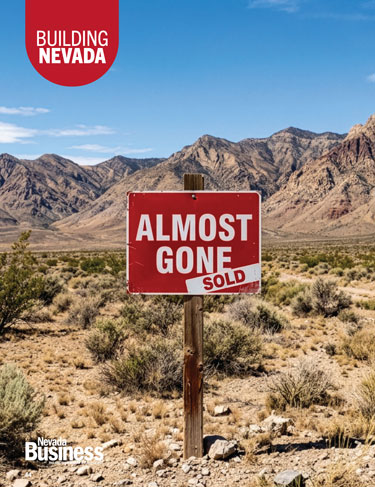
All of which is to say that land in Nevada, whether desired for residential, commercial or industrial development, is at a premium. Even with 110,500 square miles, Nevada is running out of land.
Land Challenges
There’s still some land in Northern Nevada that’s ready for residential development, even some with infrastructure already in place.
“But it’s rapidly absorbing, especially in Reno-Sparks,” said Krueger. “In fact, most of our remaining land is sitting in larger planned unit developments that, unfortunately, require significant capital investments to unlock and get going.”
Much of the remaining supply in Northern Nevada is in submarkets like Fernley and Dayton, outlying markets that are starting to see significant activity as land in Reno-Sparks becomes more limited.
Even where there is land, another condition unique to Nevada requires developers to provide infrastructure – sewer, water, gas and electric. “So in a lot of cases you’ll have parcels of land that have been zoned or entitled for residential, but that infrastructure won’t come in until the development is actually initiated,” said Dan Morgan, CEO, Builders Association of Northern Nevada. Currently, infrastructure is going in on Quilici Ranch in South Reno and Talus Valley in Verdi, two new residential developments.
Those may be the last tracts of land available for residential development in Truckee Meadows. There are also some parcels that are entitled but may never be built, Morgan said. “But right now, available land that’s not already entitled or in process of development is very limited. There isn’t land available for another large-scale development like Damonte Ranch or Somersett. The land is just not there in the Truckee Meadows proper.”
Part of that is due to Nevada’s topography. A lands bill might free up acreage. “But you have to take into account that Nevada has more mountain ranges and more topography than any other state in the continental United States, and we can’t build homes on the sides of mountains,” said Morgan.
That’s in part because the slopes are too steep to build on, and partly because local municipal and county codes don’t allow it. The infrastructure costs aren’t workable without enough density to make sense, and getting that density is too hard on a mountain.
Southern Nevada developers are pushing for an additional lands bill as available land, whether needed for residential, commercial, or industrial use, is running out.
“There’s roughly 23,000 acres remaining for development in Southern Nevada,” said Tina Frias, CEO, Southern Nevada Homebuilders Association. That land is currently within various municipal boundaries and has already been congressionally identified through previous land bills.
“There are also infill projects that builders have, projects they’ve moved forward on or that are currently in the works, and it’s really a case by case basis,” said Frias. Those might come into play where a project makes sense because it’s not cost-prohibitive and there’s enough infrastructure in place to move forward. “Second, given the cost of the land, infrastructure improvements, and construction cost is going to enable the builder to build a home that a buyer can qualify for.”
Investments of Time and Money
Even when land is already entitled, delays still occur. Compared to five years ago, subdivisions in Northern Nevada are taking much longer to build.
“Five years ago, once you had a parcel of land and it was zoned, it would take you about a year to process entitlements, get all your maps and everything, and get ready to break ground on the development,” said Krueger. “Now I estimate it’s closer to two years, and it involves everybody.”
It involves the jurisdictions overseeing the development, which are undermanned and taking longer to process. Apartments move through the process faster because, if the parcel is zoned, developers can bypass the entitlement or public hearing process for getting maps approved and working with city councils.
The fact that the developer pays for infrastructure that’s turned over to the municipality means that, even before the first house breaks ground, capital is invested in the community. “Potentially tens of millions of dollars of infrastructure is put in place before you can even build your first home,” said Morgan. “It really only makes sense for the development community to expend those dollars when they know there’s a timeline they can recapture it.” It’s one reason some entitled projects aren’t building.
In Southern Nevada, it can take anywhere between two and four years from finding land to starting development. “It depends on the size of the project, whether or not we’re looking at private land or federally owned land, whether or not we’re going through the BLM land disposal process. It all varies,” said Frias.
That range means builders invest quite a bit of capital in the community before they even begin selling houses.
Making the Most of What’s Already Available
Infill land is typically used for commercial projects, but residential uses can compete. They just need to be high-density multifamily projects because those are the only projects that can compete on price against commercial uses. The rest of residential uses are pretty much priced out on infill property, said Krueger.
Size is a factor. Infill parcels aren’t always large enough for residential use. A handful of subsidized apartment projects in Northern Nevada have been able to utilize infill properties because they can use smaller parcels.
“There are some infill lots available for, not necessarily multifamily, but for duplex or condominium type projects where you could potentially get the density. But the land costs have escalated so much and the infrastructure costs have escalated to a point where it’s difficult to get it to pencil,” said Morgan. “Or make it attainable to where we’re not at that median of $500 to $600,000.”
The price of single-family residences and the lack of land to build them on have driven the apartment market, especially in the north.
“There’s been a lot of activity up here and [apartment land] is nearly gone in Reno-Sparks, primarily because apartment absorption has outpaced our new home sales literally for the last three years,” said Krueger. “I think obvious reasons are our elevated home prices up here and interest rates nobody wants to pay, so essentially a lot of new residents coming in prefer to rent instead of buy. The apartment market has been extremely strong.”
That said, Krueger expects the apartment market may level out over the next year or two as available land for multifamily projects dwindles and there’s additional activity on the For Sale side of the market.
One step in that direction is the Nevada legislature’s AB-540 which was passed. The bill created the Nevada Attainable Housing Account and set forth allowable uses of the money and conditions necessary to receive it.
Southern Nevada builders are utilizing infill properties when possible. One project in Henderson comprises nearly 1,000 homes. Another at South Las Vegas Boulevard totals 275 homes. A third on Boulder Highway and I-95 has 219 homes. Another project at the shuttered Cashman site is slated to include 1,500 workforce housing units. A smaller infill project at Paradise Trails will offer 29 homes.
“We support infill projects when it makes sense, and we can build a home that a buyer can qualify for,” said Frias. “A home too expensive to build is too expensive to buy.”
Single Family Residence—For Sale—SOLD
All those homes, all the available land and infill land in Nevada cities, and still there isn’t enough land or enough homes to keep pace with demand. Scarcity continues to drive prices up.
“The median price of a home in Washoe County peaked at about $620,000 during the pandemic in 2022,” said Morgan. “[It] stabilized a little bit between $500,000 and $550,00, and now we’re back up—it stabilized in 2025. Now in the first quarter of 2026 it’s about $580,000, and that’s roughly more than double what it was in 2015.”
Prices have soared in that 10-year period, so there’s a lot of pressure on the market. “As everybody is aware, everything from pipe to roof shingles to cement have escalated significantly, and that’s driving part of it,” said Morgan.
The cost of materials and construction, along with limited developable, appropriate land, make homes unattainable for many buyers who continue to move to the state.
Washoe County’s population grew approximately 15 percent between 2010 and 2023. Demand is there. Supply isn’t.
“We continue to grow into a major metropolitan community,” said Frias. “We are roughly around 9,000 permits that we are estimating for 2026. Our community typically has residential construction development around 11- to 12,000 permits per year. However, with the limited amount of land that’s available, there are only so many projects that can come online. Due to those land constraints, we have a significant challenge keeping up with the pace of growth of this community.”
Even rural counties can’t keep up if there’s a flourishing industry in place. Communities in counties with active mining need to provide workforce housing, but even if there’s land available, construction may not be—the cost of bringing materials and labor too far into rural areas is cost prohibitive.
Reno-Sparks is keeping pace with population on the rental side of things, with apartments and townhomes, but the for sale side has been under 1,500 home sales annually since 2022, for reasons of supply, market and cost to develop.
“We have steady migration from California which is doing nothing but pushing our house prices up, which is fine. I understand why people from California want to come here, but it’s putting pressure on the supply of homes,” said Krueger.
And on land available for the homes and for new buildings when businesses want to build and own. All of it drives up land prices and drives down availability.
Infrastructure isn’t keeping pace. Washoe County and outlying markets are reaching their limits on facilities, primarily sewer and water issues, leading to discussions on how to raise fees to expand those utilities. Constraints won’t stop development, but it will slow it down as solutions are sought.
Data centers locating in Nevada require massive amounts of land. They stress power grids and future power capacity, and use water Nevada doesn’t have. They’re one more challenge to Nevada’s available land.
Other industrial land uses need smaller parcels; infill is often a good fit. Sometimes there’s initial competition between commercial and residential developers for raw land, but it’s not a true competition. “Homebuilders want the community to be conducive to providing the services and amenities that our buyers need, so commercial development is part of the community that attracts our buyers.”
“Builders are getting more and more creative, putting in major investments, doing everything that they can to make homes attainable. However, the land challenges are significantly impacting on business,” said Frias. “Roughly 40 to 50 percent of the cost of a home is correlated with the land and infrastructure improvements. Being that our land prices are anywhere between a million to $1.8 million per acre, that coupled with the fact that construction costs, the cost of materials, has gone up significantly over the past five years—around the 30 percent range. It has made it more and more challenging for projects to pencil. The land issues that we face in Nevada are unique and make it very difficult for the residential construction industry.”
“AB-540 took some really good steps with some area median income adjustments to promote the development of more attainable housing,” said Morgan, who serves on the Nevada Attainable Housing Council. “There are grants available from the state and it was a good step for Nevada, but what it comes down to is the tip of the spear is really having land to build and having land inventory to create housing inventory. That’s really the challenge we have now.”