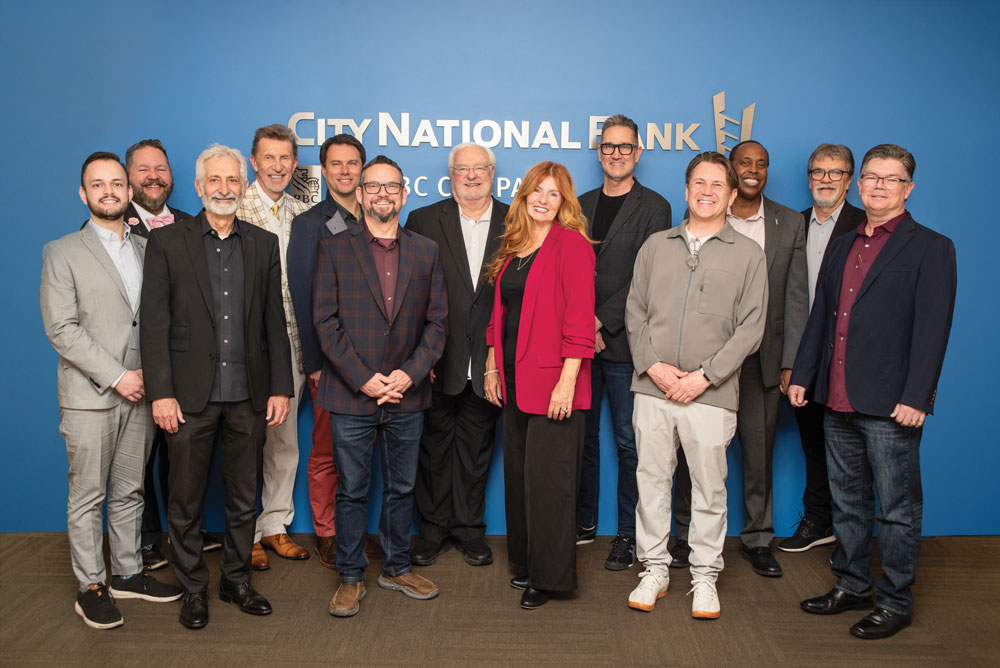
The architecture industry in Nevada is as old as Nevada itself. And architects have always maintained a level of public respect for their contributions. However, in recent years their reputation has waned, and the industry is struggling to produce the next generation of architects in Nevada. Plagued by limited natural resources, bureaucratic red tape and limited education options to equip the future workforce, the industry is shifting while struggling to overcome its challenges. Recently, a group of architects met at a roundtable sponsored by City National Bank and held in Las Vegas to discuss their industry.
Connie Brennan, publisher and CEO of Nevada Business Magazine, served as moderator for the event. These monthly roundtables bring together different industries to discuss issues and solutions.
What Is This Industry’s Reputation?
Dr. Robert “Bob” Fielden: [According to] a national survey, within the last 20 years, a slide has occurred with architects. Twenty years ago, the [group of] people most respected [according to the surveys] was people of the cloth. Number two was airline pilots, number three was architects, number four was doctors and number five was attorneys. That has [changed]. Now the people at the top [of the list] are entertainers.
Edward Vance: Of all the professionals though, we still are held in high regard.
Fielden: We are held in high regard, but not to the degree that we were 20 years ago. The reason for that is because we have not done our job as architects and not in terms of health and safety, [but] in terms of public welfare. That is where we have fallen.
Jeff Frame: Our biggest challenge is not to be a commodity. [Architects] bring a lot of value to the table as far as design, city planning, and urban planning. [The challenge is to not] be thought of as a means to an end.
Brett Robillard: There is this weird conundrum where architects are celebrated but not valued, whereas attorneys [for example] are valued but not celebrated.
Dwayne Eshenbaugh: I would still rather be us.
Jason Andoscia: [We have access to] so much data and tools as architects. I would argue that if we [used them] wisely and took advantage to leverage them, our esteem would rise. But what we have done is allowed other contractors to come in [resulting in] a specialty being created because we did not capitalize on opportunities. We have been risk averse and it has been to the detriment of some our [public] esteem.
Eshenbaugh: Our profession is under attack, and it has been for a while. Design build impacts what we do. It is on TV everywhere. There are DIY shows [with] people that are not architects, they are not even licensed designers, but they have TV shows and they are doing great stuff.
Carlos Fernandez: People respect architects, but they do not know what they do. Now [architects have] a great opportunity to not only train the new generation, but help policy leaders understand what it means to be an architect. That way they are not chipping away at a profession of people who care about the health, safety and welfare [of the community]. But that is a threat. Education is a threat. And the lack of us not taking those opportunities, being risk averse and allowing other people to take on the profession is an issue.
Fielden: There was a time when the architect had an image based upon the welfare [of the community]. It was not [only] based upon health and safety. We are all competent and qualified in that area. We have forgotten our role and responsibility in terms of quality of life and the quality of work that we create. Thank God someone from the outside came along and did something like the Sphere [in Las Vegas] that opened us up to new thoughts and new thinking. [There is] also a ballpark that is coming for the A’s, that is going to make the Raiders stadium look like a class B operation. [That is] good for us. That is important.
What Does the Future Workforce of This Industry Look Like?
Howard Perlman: My immediate concern about our profession is that we do not have enough people to hire. It seems like we get most of our resumes from California. We have a very small pool of people [in Nevada] to hire.
Eric Roberts: The biggest struggle is lack of experience [in our current workforce] and the inability to find quality people at our firms.
Fernandez: Many people have mentioned that a lot of the resumes they are receiving are from California [and that is likely an education issue]. We have one institution in the Nevada system of higher education, which is UNLV, that has a master’s degree program and is accredited. The Meadows Community College is in the pipeline for a five-year bachelor of architecture.
Robillard: Some of the candidates we have seen over the last five years [from UNLV] were not being trained in Revit. They were coming out of school using Rhino, which is a great modeling program, but our common production tool is Revit. Most [architects] use that [program].
Fernandez: The concern is that [our education system is] not producing a workforce that is ready. A lot of our members are having a problem with [that] and are stepping into different roles in order to find a solution. [They are] working with UNLV and the Nevada System of Higher Education in order to produce architects that can be licensed here, work here, and design for the communities around us.
Vance: Schools have always had a gap between the academy and the practice. The academy does not feel it is as important to teach [students] to be architects or businesspeople. The pro practice classes leave a lot to be desired. It is the internship, the three, four or five years, and in some cases ten, that teaches not just architecture [and] dealing with jurisdictions, but also how to run a business. The elevated question for your partners that are going to take over becomes, how do you train [future architects] to run a practice which is completely different than just being an architect? They do not teach us that in school.
Andoscia: The divide between academia and practice is an age-old problem.
Lance Kirk: We are seeing a gap in training and mentoring [new architects]. When you do not have people coming into the profession and people are leaving, there is a gap [in] gaining skill sets and knowledge of the practice. We are having to focus a lot more attention on that.
Eshenbaugh: We are on the cusp of a transformation among the firms. The younger people that have been there for all these years are taking leadership positions. The founders are retiring, and it is happening across the valley because they all started at [approximately] the same time.
Roberts: We are losing architectural talent with boomers retiring and we have a generation [of architects] missing that is not coming in.
Andoscia: [The shortage of architects] is exasperated [in Nevada]. It is a national [issue though].
Eshenbaugh: After the last recession, [around] 2008, many architects left the profession. They became school teachers and they worked for municipalities. They did a lot of different things because there was no architecture happening. They left, and that has left a huge void. We have this vacuum now that we are trying to fill.
Robillard: A lot of people also left during COVID.
Andoscia: [Remote work] is a new reality [because of] COVID and now there is a tendency [to emphasize] its value. Some of the folks we are hiring are remote and they could be anywhere in the United States. [The question is] how do you mentor them [when they are unable] to pop in the office at any time? And [because] the architecture design we do is community driven, how do you provide that ethos through them if they live in different communities? How do they begin to engage in their own community in that way? It is a huge issue.
Robillard: We have had to focus on [staff in the office] and had to remind [our young architects] about [the value of] mentorship, which they do not necessarily immediately recognize as important, because the flexibility of working from home feels much more appealing. We have had to augment some of our day to day and week to week office culture to be more enticing to get them into the office, which is disappointing. But it is a fact of the matter in today’s world.
Andoscia: Young professionals coming out of school today, if they are not in the office, are missing out on so much. I do not think they realize it. They look at [remote work] as [a matter of] flexibility and work-life balance. Those things are good, but as far as mentorship, [there is value in] hearing someone on a phone call, or [observing] how a principal handles something, or in going to the building department or a planning commission hearing. Those things are so valuable. The younger generation is missing out.
Robillard: We are having success with getting people back in our offices locally. But as a firm, we have 53 offices. It is difficult. We have 50% in office attendance, and [we believe that] when you are not in the office, you are not productive.
What Factors Impact the Productivity of This Industry?
Frame: We have all talked about the influx of people moving [to Nevada] from California. Guess who else is moving here from California? Administrators and code officials and they bring their reference of California with them. They are infiltrating our jurisdictions with their mindset. [And it is] dragging out the processes that we [already] go through.
Vance: For example, we are doing a master planned, residential community, [that is] mixed use and it must be 40 acres. My partner has been working on [the project] for two years, and we still have not got the submittal yet to plan because they go round and round and change and change. We need to put up a sign at the [Nevada] border saying, leave your ideologies with you.
Roberts: We are also challenged by cities, counties, and utility companies, who are also dealing with the stripping away of talent and the memory of what [developed] Nevada and our cities. We struggle to find people to keep the wheels turning and the progress that we need for our clients to get their projects done. I [frequently] run into problems with the authorities having jurisdiction because they are understaffed. They have people who do not understand the process, and that slows things down. It is a lack of base knowledge on the design side and on the approval side, that slows down our development.
Vance: Each [municipality] is trying to do better than the next. Some of our code officials are trying to build a coalition among the building and planning departments to create a base that we can all live, operate and work in. [Currently] I can design the same building on all four corners of [Las Vegas] and I would have to design the building differently, which is silly.
Roberts: We used to have exceptions that every jurisdiction would accept because they all got together and said in southern Nevada, we interpret the code this way. That [process] takes work and takes effort, and if they are stretched thin, the easy decision is to make another rule and come up with something that has already been done.
Vance: Getting things through entitlements used to be a breeze, but they keep adding regulations, which adds to the cost of the project, which adds to inflation. I am trying to reach out to my commissioners at the county, which tend to be a challenge. North Las Vegas has at least gone to some in the city form-based code, which has helped us get our projects through more quickly. But businesses want to come [to Nevada] because we are business friendly. And if we look nationwide, we are not bad. We have work to do. We need to improve.
What Challenges Does Natural Resources Pose?
Eshenbaugh: The biggest challenge [for our industry] is sustainability. The depletion or scarcity of [our natural resources] is the biggest issue that we face. We continue to go outwards instead of looking inwards, and that is going to have a tremendous impact.
Fielden: The biggest issue facing the design community and the design profession in the future in not only southern Nevada, but northern Nevada as well is climate change and the impact that it is going to have on us in the next century.
Coulter: Water is probably the single biggest challenge right now and making sure that we develop some type of plan that helps us sustain our economy and our city.
Fielden: The issue is going to be extreme temperatures. We are going to have 125 degree temperature days here. Air conditioning systems do not work at 125 degrees. So how are we going to provide growth and development here? We are going to have to find ways to insulate ourselves and protect our living so that we can continue life here as we know it. We have to consolidate our land use rather than keep moving out. And we have to find and define ways of making shade and creating shade for us.
Eshenbaugh: There are a lot of trees in Las Vegas. We need more green space in the urban core. But last summer really impacted the existing trees. They started dying off. [Some of] those trees had been here for a long time.
Fielden: Back in the 70s when we had more water, we started bringing in pine trees and other trees that are not native to this region. We can certainly bring in drought tolerant plants that are used all across the Middle East and in the African deserts to work here. But we have not done that. So [now] we have all these decorative pieces that are going to have to be replaced because we need shade. We must get rid of the heat sink.
Perlman: We are going to run out of land eventually if the BLM does not release any more. We are almost at the borders of the BLM, so the nature of our development is going to change. We are going to end up having to redevelop areas.
Fielden: The water issue will get resolved because we will find ways to desalinize and reuse water the way we do here in southern Nevada that will be able to accommodate managed growth. But it is going to have to be managed. And it can’t be in the way we have historically approached it in the past.
Perlman: We all [currently] have plenty of water. The people in charge are going to figure something out. We are going to have water, and people are going to keep moving here, especially from California, and we are going to have power. And if the BLM releases some land, we are going to have more land to build on, but if they do not, it is going to force us to recreate some of our communities.
Kirk: Resilient design is going to be the future. We are going to have to adapt. How we build now is not how we are going to build in 10 or 20 years in Las Vegas or the rest of the country [due to] water issues, rising dryness, and fires. We are going to have to approach our design differently moving forward. What is codified now for minimum energy or for insulation values is going to change. We are going to be forced to adapt. And how we grow and build from that is an opportunity we have.