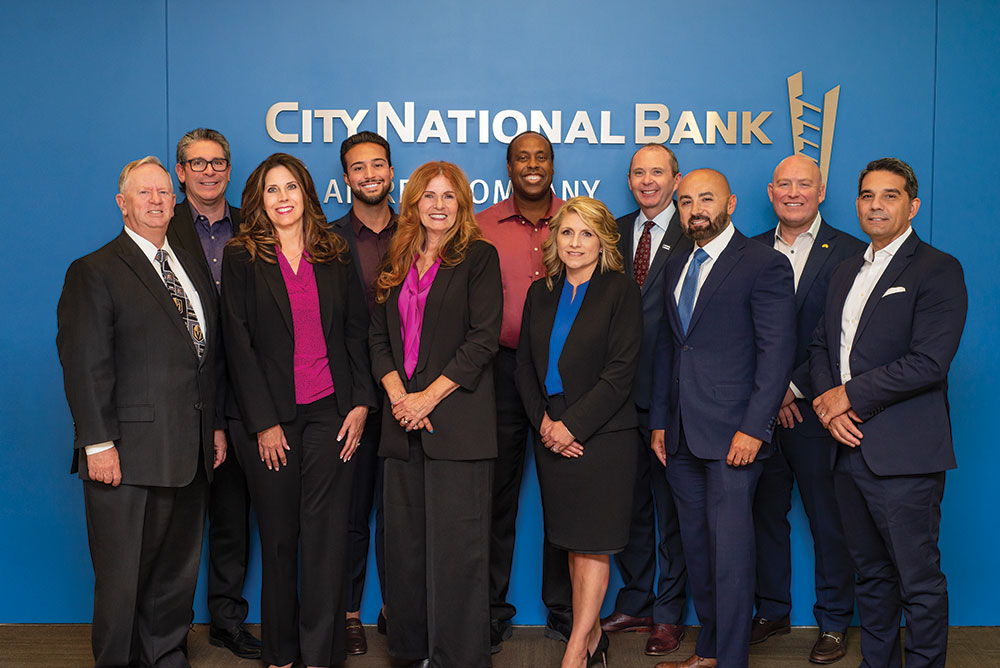
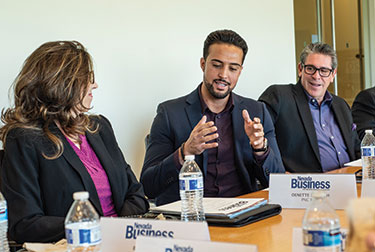
From the recent COVID pandemic that resulted in a changed workforce, to rising interest rates and an overall lack of trust in the industry, bankers have had a front row seat to a dynamic market. These challenges have resulted in bankers becoming more focused and client centered. Recently, bankers met at a roundtable sponsored by City National Bank and held in Las Vegas to discuss banking and the future of the industry.
Connie Brennan, publisher and CEO of Nevada Business Magazine, served as moderator for the event. These monthly roundtables bring together different industries to discuss issues and solutions.
What staffing challenges is the banking industry experiencing?

Michael Woodfield: Getting good quality employees to come back to work after COVID has been a challenge not only for us, but our clients. We are hoping that improves.
Bob Ceminaro: The at work and remote work situation with Gen Z and the younger generation [is challenging]. It is striking that balance. Our business is a customer facing, at the table, conversing type of business and it is very challenging to do remotely, or at least do it right remotely. It is going to be interesting to see how the next generation evolves into a balance of working at [an office] versus working remotely.
Stacy Watkins: I am seeing a higher level of demand for diversity in the workplace and interest to come into the workplace. I have some people who are hybrid [with their schedules]. They work at home remotely and they are in the bank.
Brian Formisano: As we think about employees and the way that the employee experience has been leading up to this point versus today that is where our biggest opportunity is. [We need] to make sure that we are building the right structure to ensure that we engage those employees for the future. When you think about remote work versus in person work and the balance between, it is difficult to find good talent. And then when you get good talent, [it is important to] make sure that you create the environment where you can retain them for the long term.
Terry Shirey: We all struggle with the amount of talent in our market. We move people around amongst this small group and are fighting for the best ones.
Robert Sandhu: Right now, the demand for talent is outweighing the supply. I have had about four or five very talented individuals that some of my colleagues here around this table snatched away from me. It is a very competitive workforce. It is not just affecting the banking industry; it is affecting all industries.
Ceminaro: [The biggest challenge I face] is succession planning and trying to find that younger generation that has an interest in banking and [wants a] career path in banking. All of us probably at some point went through one of the larger banks training programs. They dismantled those, which was a significant pipeline for our industry. I know a few institutions are trying to implement those training programs.
David Navarro: The cure to all this is having more qualified people coming into the industry at the start, which is why [there is so much] investment going into UNLV and CSN. Many of us are a part of that. We are already starting to see some of the rewards from that labor with some students entering into the pipeline and having full time roles or internships.

James York: As an industry, we are trying to solve the problem by training [bankers] from the beginning, from the college level and up. But that takes time to do. It is going to take a generation to fill the void.
Formisano: Industry wide we all do a good job of communicating in terms of opportunities. Several times [there has been a situation] where [a bank] has somebody inside their organization that wants growth [and] they are looking at other industries. [That specific bank] may not be able to offer that person what they need for their future, but they can pick up the phone and [direct them to an opportunity somewhere else]. It feels awkward to do that. Why would you give away your talent? [Because] if you are building bridges internally, that helps everyone at the table. Having that communication, leadership wise, and at the banking level locally, helps build bridges and keeps people in our industry versus skipping and going somewhere else.
Watkins: I have people who want to dabble in multiple roles and we are building out department models that give folks the opportunity to play in multiple spaces. We like to say that we are a private bank for our clients, but we are also a private bank for our team members. [We focus on] providing tailored solutions for each individual colleague and team member and finding out what uniquely is going to drive them and motivate them. It is transforming into this really unique workspace.
Navarro: The biggest prevention to staffing issues is creating a culture within your team. And that gets harder as you scale. But creating a culture that amplifies joy and fulfillment [is essential].
What security issues does this industry face?
Shirey: It has been interesting because we all talk a lot about cybersecurity, but we are seeing a lot more of what we consider old school check fraud. It is a very large issue in the last year because banks have gotten a lot better at cybersecurity. Since chips and credit card ATMs have prevented a lot of fraud, [fraudsters] have gone back to the old way of doing things. [As a result, we focus on] training our people and spending time with our team to help them identify fraud at the seller line with things that they probably have not seen for a long time.
Watkins: If you think about COVID and how that impacted the utilization of mobile banking and how people are doing traditional services, people want their cake and eat it too. They want the convenience [of a physical branch] and the speed to be able to do their banking [electronically]. And that is why there is a heightened increase of traditional fraud that is occurring. We are [also] still seeing some robberies, but it is very minimal.
Sandhu: It is a balancing act too. Because you want to keep it as convenient as possible for your customers, but they might complain about the verification process. But we are doing that to combat these cyber issues because they are getting better and better each and every year, which is scary.
Woodfield: You need a secure ID token now to get into banking and some people do not like it. But you have to explain to [customers] the reasons why it is there. We are doing it to protect them as well as the firm.
Ceminaro: Your first line of defense is always going to be employee and customer awareness and education, regardless of how much you are spending on technology and whatnot. Online fraud in 2022 was over $10 billion. The magnitude is there, and it is not going to change regardless of cloud sophistication and whatnot. It is consumer and employee awareness [that will minimize it].
York: The banking industry is the strongest industry in the country and probably in the world, for cybersecurity and IT for prevention. Because to operate, no matter what size [your bank is], there has to be technology in place and the talent and training has to be solid. It is just a requirement.
Suddeth: One of the ways we stay ahead of [cybercrime] is educating our clients. A lot of cybersecurity [threats] are being perpetrated through emails. Business email compliance is one of those things that we can directly educate our clients on. As an institution, we do everything we can to continue to enhance and improve that.
Formisano: It is interesting because the younger generation is actually more in tune with the risks from a cyber perspective. They are the generation that has three or four different social media profiles because they recognize that their profiles are at risk for these things.
Woodfield: Banking is 50% of my job, the other 50% is education and a lot of it is around cybersecurity. A lot of it is through education, business email compromise, callbacks, things like that. We spend a lot of time and invest a lot of money in technology to help prevent and get the news out there of the latest threats that are rolling out to help prevent it and protect the consumer.
Formisano: We are investing our time and energy [into education]. We are not just [investing in] technology, but in making sure that our bankers are taking a slow, deep dive with every relationship, so that way they can educate on the common things. When [customers] are doing a wire transfer and get an email with instructions or when they get a random text message that says they identified a transaction [and it directs them to] click a link to verify [we educate them so that] they know what to do.
How have the recent bank failures impacted this industry?
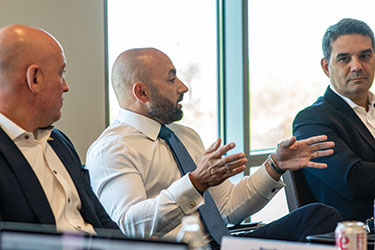
Formisano: We saw an immediate rush of education that was necessary. There were a lot of folks that were coming in and asking questions about the stability of all banks. And I think what we did really well, at least locally here in Nevada, was continued our partnership and communication so that way we could make sure that we did not fuel any type of emotional distress within the market.
Navarro: When you have two banks failing in such close proximity to one another in a very short time frame, it leads to systemic concern with all the banks. And that is what we saw initially.
Shirey: It did reinforce the importance of a community-based business model and having diversity on your balance sheet. As bankers we always think about concentrations in terms of our loan portfolio, that we are not too concentrated in particular asset classes. [Because if] there is an adverse event, it can really impact you. It is important to have a lot of diversity.
Ceminaro: What we experienced was a modern-day runoff where technology and social media played a very significant role in this. [We all saw how a] CFO and treasurer can press a button and suddenly billions are out of your bank or your institution. Social media creating a fear factor was significant. It was a significant component regardless of the financial strength of the institution.
Navaro: The system is very much intact. Now that time has passed and you are seeing what the issues were with some of those specific banks, and not all those issues applied to every other bank that was affected just by the share price. That is pretty revealing. These banks were regulated, and it becomes clear that management of these banks is important.
Bruce Ford: One of the things that calmed everyone was when the consortium of banks deposited money in some of the probable failing banks, and I guess one of them ultimately did fail. Industry wide we recognized that the regulations make some sense and if there can be overall trust in the system, that is good for all of us.

How has the interest rate environment affected loans?
York: The interest rate environment has caused an impact on deposit rates. [Before the stark increases] and pre COVID [people] were not interested in rates and nobody was really paying rate. That changed within a few weeks, [almost] overnight.
Shirey: [There is] definitely a lighter demand [for loans], but some of the strongest loan demand I have experienced was last year. It was a low cost for borrowers. Our city was experiencing a lot of growth and we had a very strong economy. And now it’s not.
York: With the higher interest rates, it is difficult for investors in the real estate investment industry to pay a higher interest rate on their loans. Their cap rates are often challenging and they do not have much spread so it is slowing loan demand. [Also] they have loans that are going to be maturing and are already maturing in a lower interest rate environment at a 3% rate and now they are going to have to mature and get a higher interest rate. Can they afford the payments? [It is going to result in] some softening in the commercial real estate industry and the home mortgage market because mortgages will be maturing. People are not going to be able to afford their new mortgages either.
Shirey: Loan demand has definitely declined a lot and you are going to see loan growth moderate and we are certainly very much focused on deposits. That is the other big kind of mindset change that we all went through very rapidly [where we realized we had been taking] low-cost deposits for granted. That changed very quickly. Our clients now understand their deposits have some very real value and we need to compete for those deposits.
Ceminaro: Customers have other options now versus traditional banking channels. Private credit is a huge component to the market now as a direct competitor to banking institutions. But [demand for loans] is really going to be dependent on interest rates and where interest rates go. But the big component is private credit and the role that they are going to continue to play in our industry relative to loan demand.
Shirey: Interest rates are the short-term and immediate issue. If we are dealing with a new dynamic in this rate cycle where we are not only competing against each other, but against these treasury money market funds and new products, that makes it more challenging.
Sandhu: I hope [the Fed] hits the pause button and does a wait and see approach. [There has been a] 500 basis points increase in the last 18 months, and I do not even know if we have seen the full effect of those hikes just yet. We are starting to see it in real estate. That has definitely slowed down on loan demand and that is tied directly to interest rates.
Ceminaro: As an institution, we are expecting the Fed to pause [rate increases], but we are also on our toes as well. If they increase it by another 25 basis points, it is not going to be a surprise either. I certainly do hope that they pause, but we will see soon.