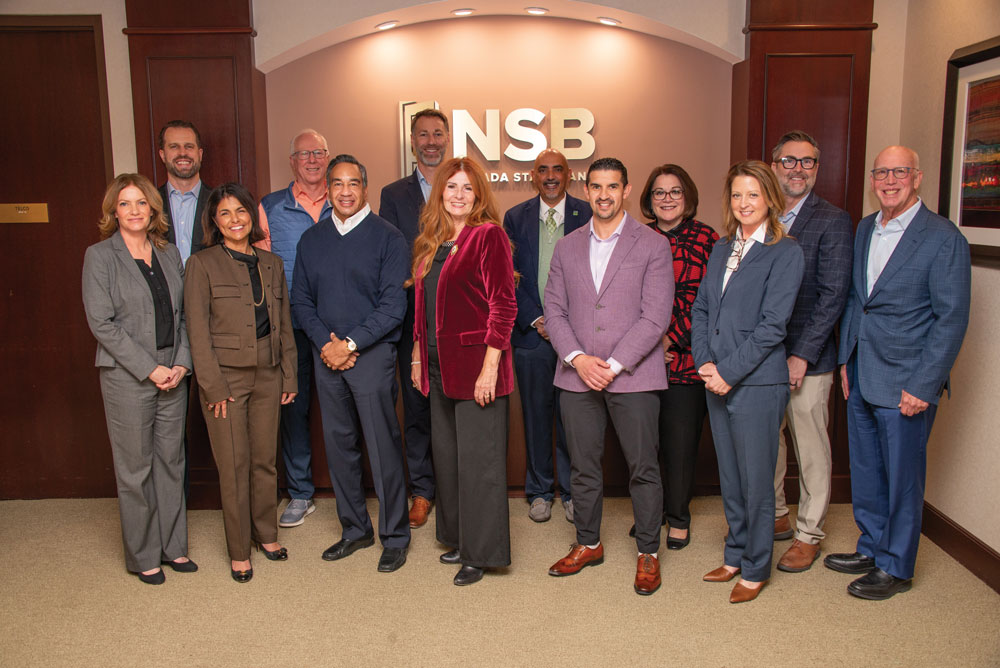
Healthcare is complicated and it is easy to become overwhelmed by the system. This is true for patients as well as providers. However, despite the immense challenges facing Nevada including obstacles of physician shortages, insurance affordability and access, healthcare in the Silver State is improving. Recently, a group of experts in healthcare met at a roundtable sponsored by Nevada State Bank to discuss the industry and the many challenges it faces. Connie Brennan, publisher and CEO of Nevada Business Magazine, served as moderator for the event. These monthly roundtables bring together different industries to discuss issues and solutions.
Is Nevada Still Struggling to Attract Talent?
Dr. David Steinberg: Recruiting is very hard, not just for physicians, but for technologists and nurses. It used to be a calling and then it changed from a profession, to a calling, to just a job. Taking care of people is intense, and taking care of dying people is even more intense.
Lisa Santwer: The challenge we have in terms of recruitment goes beyond just the medical landscape. It has to do with how we sell our city. It is very difficult to recruit when we are on the bottom of the list for education and when newspapers are reporting that we are running out of water. This used to be an affordable place to raise a family, and now it is hard to get a house. It is very challenging to recruit physicians to our market. We have had some success this year, but the conversations that we really struggle with are not if they want to work at our practice or be in our business model, but about the quality of life that they are going to have and whether or not they can raise a family here.
Chris Loftus: We really try and emphasize the package [when recruiting]. We tell them not to just look at the dollar figure. Nevada is a state with no income tax, you will be near an international airport, the weather is great and there are all of these great things here. But many young people right out of school are in debt and all they see is an initial number and they go after that instead of the package.
Steinberg: As much as we do not want to admit it, a lot of our providers are not paid adequately, especially compared to other professionals. The whole world after COVID experienced a paradigm shift. We have shortages of radiologists, we have shortages of nurses, we have shortages of PAs, we have shortages of techs. It is a pervasive problem. Frankly, it is worse because in Nevada, we are still growing as a state.
Dr. John Rhodes: The money has to be there and the base salary has to get their attention. But beyond that, they are asking how many hours they have to work and how many patients are on their schedule every day. There has been a shift to what a lot of clinicians are referring to as their life-work balance. For a lot of us when we got into medicine, we went in to be a doctor 24/7. It was more of a life-work fusion than a life-work balance.
Katherine Vergos: I moved here two years ago and had never visited Las Vegas prior to coming for job interviews and absolutely fell in love with it. It is a valid point that unless you have spent some time here, you do not realize that it is a true gem. The question is, how do we elevate and explain that? We have great healthcare organizations, so the question becomes, how do we sell ourselves to physicians when they can go anywhere right now given the number of openings around the country.
Steinberg: When you get a doctor who wants to come to Nevada, they have already gotten 50 other offers. They can leave this morning and get a job in the afternoon.
Santwer: We have really had to get creative [with potential recruits]. We put them up, we take them to nice dinners, and we walk them around our clinics. It is a whole concerted effort. When they leave here, our hope is that no one else is putting in quite that much effort.
What Challenges Does This Industry Face With Affordability?
Matt Harris: One of the primary issues is the unsustainable rise in cost in employer healthcare. We are seeing average renewals currently between 10% and 20%. It is unsustainable for a lot of employers.
Kamal Jemmoua: Employer groups go through a year of shopping and end up having to take that 10-20% rate increase, or the benefits get cut significantly. That means the member or the employee, when they have to get access to care, are going to have to pay a lot more out of pocket, which then puts pressure on the system. We are not going to solve the issue completely until we align economics more intentionally. One of the biggest detriments that we created in the healthcare system many years ago was the employee health benefit program because we took away the responsibility from the consumer completely. The buyer of healthcare is not the consumer. We need to push some of that back so that the consumer starts to put more pressure on us from a provider system perspective, and starts to realize how much things cost, and take better care of themselves.
Loftus: The costs are exorbitant. In the last 22 years, Medicaid reimbursements have gone up 5% and the cost of healthcare has gone up 71%. The expenses just keep going up. This provider fee program is getting reduced through 2032 from 6% of our revenue down to 3.5%. That is $2-300 million a year. Where do you make that up? Then the premium tax credits for the Nevada Health Insurance Exchange are going away which has 110,000 people in Nevada on it. 94,000 of them are at risk of falling off completely. Then the premiums are going to go up 26%. The message is probably going to get the most attention if the rest of the public understands the cost shifting that is going to happen. Everyone else’s premiums are going up because of it. That is where it becomes harder on employers. It is going to get worse. Medical malpractice premiums have also gone up. It is a little scary.
Harris: We are going to see in the insurance world what should not happen, which is we are going to have only the people who really need insurance, getting the insurance. Claims are going to spike, rates are going to go up, and then these insurance carriers have nowhere to shift costs other than the employer market. We continue to see these headwinds in the rising cost of healthcare and there are no signs of it abating, at least right now.
Vergos: It is not only our own costs of running a healthcare business that are a challenge, but also the cost to the employers and the cost to the patients. It is cost on all ends. How do we try to minimize that and be most efficient, but yet provide high-quality care?
Rhodes: We cannot continue to have a medical inflation rate that exceeds the general inflation rate and be successful.
Dr. Amir Bacchus: If you think of the overall expense, why are healthcare costs so high in the United States? It is because we are not preventative medicine based. People don’t do what they should be doing, which is eating right, seeing their primary care physician and preventing cancer risks. When you think of the cost per patient today versus other countries, we are three times as costly. That is because most Americans want the choice to do the things they want. There is nothing wrong with choice, but if you are not doing the things that you need to do to manage your health because you have a good preventative base, then you will see escalations in costs.
Loftus: We spend 20% of our gross domestic product on healthcare, which is way more than any other country. I used to live in Sweden and from a young age it is ingrained in you to ride your bike and be outside. On Saturday, you go to a store and get one candy, and one [small] can of Coke and you do not eat anything else of that type of nature for the rest of the week because it is terrible for you. Our country needs that reset, but we have adults that are not [being healthy] and they don’t know how to teach it. It is a systemic problem at a young age. We just keep putting ourselves in the system. Every one of us at the hospitals can tell you that dozens of our patients just keep coming back. It does not matter how much you tell them they can’t have certain things, they don’t care. They are going to go do it, and they will be back in two weeks.
Steinberg: If we did not have diabetes and smoking, my clinics would be half as full, and it would save the whole healthcare system a ton of money. We do not emphasize that. In New York they outlawed large containers of sugar carbonated beverages and we need to fight Coca-Cola and big companies like them. If Coca-Cola was contributing to healthcare costs, the paradigm would change. But we live in a complicated world.
Jemmoua: Preventative care is not a priority in this country and has not been historically. We talk about it a lot and we try to promote it. Frankly, in the senior population programs that we have, we spend a lot of time talking about preventative care, but we need to start doing it a lot earlier. We need to prioritize it and that ties back to access. The good news is, I hear more people talk to me about longevity than I ever did before. More primary care doctors are talking about it too. The reality is that we are in a pivoting time. The question is, how are we going to move the industry to pivot in that way? We are fighting very serious forces, and the economics are not aligned.
Bacchus: Technology also drives escalations in costs and so does new pharma dynamics. Medicine in the United States really is a business. It is about spending more. I see tens of thousands of patients, and we are combating a $1 million cost for a new drug that may help a patient by increasing maybe six weeks of life. True, it can help, but at the same time we need to apply logic to these ideas.
Santwer: We do about 100 to 150 clinical trials every year and I recently heard that we need to expand access to clinical trials. We need to bring in major academic medicines to increase clinical trials. We have been doing clinical trials for years. When a patient is on a clinical trial, it does not cost them any money, and it does not cost the insurance company any money. But once that clinical trial is approved and is FDA approved, it is very expensive. As a provider and as a physician, you want to do everything you can to save that patient’s life. That includes using the latest drugs, but not everybody wants to pay for it. It is very expensive.
Harris: It is all connected. If you do not have enough doctors wanting to join the profession, that drives the access issue. Then the access issue drives the cost issue. Because if you can’t get in to go see a primary care doctor, then the preventable stuff becomes major stuff. Then that gets reflected in higher overall utilization claims, and then that gets passed on to employers via higher premiums.
How Big of a Challenge Is Access to Quality Care for Nevadans?
Vergos: Sometimes people equate quality to access. People will say that we do not have good quality care, but really what they mean is we do not have good access to care. They can’t be seen when they need to be seen. Our system here in Las Vegas is very convoluted. It is disconnected from acute care to post-acute care. There is more of a navigation and access issue than a quality issue. Because when you look at our scores from an acute care perspective, we do really well.
Karen Rubel: My biggest concern is the same that I had last year which is the increase in hospice companies here in Southern Nevada. We have about 280 hospice companies in Clark County. That puts pressure on lots of things, including patient choice, access and quality care. Patients really do not have a choice on hospices anymore.
Loftus: When people can’t go to their primary care doctor, they are going to fill up the emergency department. They are going to use that as their primary care provider. Then people are going to complain more about access because they cannot get into the emergency department, but there are a bunch of people in there using it as a primary care provider.
Bacchus: Teleheatlh continues to be a big adjunct to what we do just because of access. If you think of all the time after 5:00 PM that a patient does not have somebody around, telehealth has value.
What Is Nevada Doing Right With Healthcare?
Jackie Van Blaricum: From a legislative perspective and through the association, we work really well together. We band together to make sure that we maintain access. For example, there is a group that is trying to eliminate freestanding emergency rooms and limit access in this town. We are working together to make sure that does not happen. Legislatively, there is a lot of collaboration to make sure that we are protecting and keeping access open and bringing more people to the state. We also have a very supportive governor who supports us tremendously. He has made a huge difference for healthcare in this town.
Joseph Ferriera: A good example [of banding together] was the Transplant Institute that the Nevada Donor Network founded. We all know that UMC can provide a patient with a kidney transplant if they need it. They have been around for a long time, and they do a good job. But ultimately, every other organ that needs to be transplanted cannot be done here in Nevada. As a Nevadan, working in organ and tissue donation, that is unconscionable. We have one of the highest rates of donation in the country and the world because Nevadans are so generous. But if you need a liver transplant, you cannot get it in the state. The premise of the Nevada Transplant Institute was to mitigate some the cost factors in bringing in the talent that is needed to do those advanced procedures. And through those efforts, we were able to secure a grant from the state of $15 million that has helped attract and retain the talent, some of which is in place in Reno. And they have now begun doing living related transplants. They have done three. Now we have access points in both Southern and Northern Nevada because we took the onus and decided that instead of waiting for a healthcare system or the state to catalyze it, we inserted ourselves into the equation.
Loftus: I am the chair of the American Heart Association and we have an entire division called the Kids Heart Challenge and we go into schools all over the city and give CPR kits and teach hands-only CPR. We also teach them to eat right, hydrate, sleep well and get exercise. We have seen great impact with that and with the families invested in that.
Blaricum: Nevada is making incredible investments. Many of us have physician residency programs. HCA has 300 residents here in town and we just purchased a big school of nursing which will be the largest provider of nursing education in the country. We have 600 nurses enrolled. There are companies investing to solve the problems in healthcare and we need to get the word out around those big investments that every health system in town is making.
Steinberg: The idea that we have three medical schools here and a number of residency spots certainly is a tremendous bright spot. Luckily, we have some successful companies here that have made education a priority and healthcare a priority. Those are the companies that are making a difference.
Loftus: The big hospital organizations also continue to keep making significant investments. They want to make sure the city continues to succeed.
Blaricum: Nevada’s healthcare industry is getting better. There are a lot of great physicians who live in this community who are UCLA, Cedar, and Duke trained. We have a lot of great healthcare providers. Within HCA, we recognize there is a big gap in blood cancer services here locally, so we opened a bone marrow transplant institute. We have cut the out migration to California in half and will continue to do that. Collectively in the health system, we need to look the gaps in care so that we can prevent outmigration to other states. People deserve to keep their care local. We are better than we have been in the past and through partnerships and collaboration, we are closing that gap.
Steinberg: At the end of the day, it is really the postgraduate education in the community that has made a difference. Dignity, HCA, and the Valley Health System has really stepped up and made a difference to the community and against a political environment that is really decreasing or not increasing postgraduate spots. If they had not made the effort, we would not have the medical schools that we have here. But medical schools do not make the difference of where the physicians end up. It is all about postgraduate education. Things are better than last year. Will next year be better? Probably. But we are fighting a lot of headwinds.