Political uncertainty, limited inventory and land, and extensive red tape are only some of the challenges facing the commercial real estate industry. Added to that is the looming concern of brokers becoming obsolete due to AI and an upcoming workforce that demands higher salaries without showing up to the office. The commercial real estate industry has never been a career for the faint of heart, but it now demands more grit than ever before.
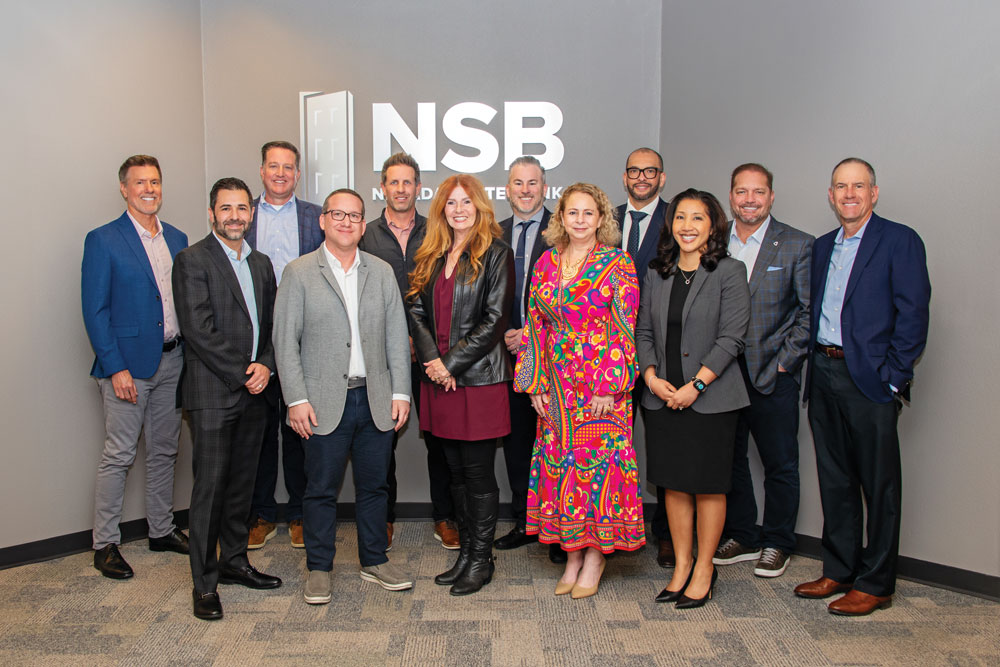
Recently, a group of brokers met at a roundtable sponsored by Nevada State Bank to discuss their industry. Connie Brennan, publisher and CEO of Nevada Business Magazine, served as moderator for the event. These monthly roundtables bring together different industries to discuss issues and solutions.
How Did the Presidential Election Affect This Industry?
Hayim Mizrachi: The biggest impact from the clients that we spoke to was more from a cognitive load perspective and we now have their attention back from watching what was happening with the presidential election. Once it was settled, they were ready to move on to other things.
Venessa McEvoy: There was a lot of uncertainty last year, and that probably carried over into the new year. Brokers have been helping their clients manage that uncertainty, and handling the risks that are coming to the surface with the economy and what is happening with the government.
Jeff Jacobs: There is an overall lack of urgency in the market. I was hoping some of that would be taken off the table as we got through the interest rate decreases and the election, but it still seems like we have that same lack of urgency heading into 2025.
Cameron Glinton: The aftershock of the interest rate hike, the uncertainty that borrowers and buyers had coming out of last year, and then the optimism about a new administration potentially putting pressure on the Fed to reduce rates, left a lot of people on the sidelines.
Daniel Adamson: All markets like predictability and consistency. We have a president now that is ruffling a lot of feathers, and you do not know how everybody is going to react. It is going to take some time for that to smooth out, calm down and get figured out.
Jacobs: Q4 was the strongest quarter for investment sales in two years. There were a lot of people on the sidelines waiting until after the election and that clarity cleared out some of the deals and inventory. There was definitely a spike in November and December in sales volume, but long term, I am not sure.
What Challenge Do Brokers Face in Getting Deals to Pencil?
Jacobs: It is tough to make anything pencil. Rents in multifamily are stagnant with maybe a slight decline year over year. Cap rates have expanded. Even though we have had rate cuts, the borrowing cost for a construction project is still heavy. Everything is working against us at the current moment.
Jeremy Green: The biggest challenge we are facing in our sector today is a combination of everything. We are catching up from high construction pricing, lender rates being just high enough that our rents do not balance out with the requirements to secure a loan and land prices are too high. The ability to pay those prices, get market rates, meet the thresholds that are needed for a new loan and meet the timelines for utilities and so forth to catch up, make it nearly impossible to convince yourself to do a deal.
Jeff Mitchell: The entitlement and approval process with municipalities is a challenge we see daily. The fact that some local municipalities are now outsourcing to California markets to help that process along is not really helping us. The past agility in Nevada and the ability to get things done quickly has been a feature of this market that has attracted a lot of investors. Now we are becoming closer to California, and that appeal is quite a bit less.
Brian Armon: There are challenges with infrastructure from water availability, power availability, and now in northern Nevada, gas. We are challenged from a development standpoint.
Green: The midbay, free standing and flex markets that support a lot of what is happening in Las Vegas, including the convention growth with the sports and entertainment industries, is underbuilt. Finding those sites, just like retail, is incredibly difficult. Winning at auction and beating out those cash buyers that are waiting for the BLM (Bureau of Land Management) to release the limited amount of industrial we have is also difficult. We need more industrial land. The inventory we have is not going to last forever.
Mitchell: On the retail side, the availability of land, BLM control and Clark County Aviation control of land, the auction process, and the selection process of those auction parcels does not necessarily fill the demand that is out there for property.
Adamson: There is not a lot of new construction. It takes a long time and there are barriers to building things with costs. Government approvals can also take quite some time. And while it is healthy and there has been rent growth, the demand is quite a bit larger than the supply is. We would love to have a new master planned community if the government would release some land and create new communities.
Mitchell: We just wrote up a ground lease where the maximum timeline was 510 days from a document execution, and they are not even purchasing the property. They are having to work through the entitlement process, the review process, and the design and if something does not check a box, then it sits on somebody’s desk for another 2-3 weeks or a month. It creates these protracted timelines where eventually we get so buried in those timelines that we almost can’t get anything done. We are stuck in the mud. And that is unfortunate because there is a lot of demand. There are a lot of users that want to open up stores, hire people, and want to increase the economic growth potential for our market, but we are getting stymied by timelines.
Green: Deals today take probably twice as long as they used to. In Las Vegas if something was built somebody would show up the day it got its COO (certificate of occupancy) and lease it. Nothing would pre-lease. It has changed dramatically.
Jennifer Weinberg: The biggest challenge for me is finding what my clients are looking for, especially on industrial, on the smaller uses. I have a lot of great buyers and can’t find any product for them.
Jacobs: Our vacancy rate in retail is 3.9 percent. That is the lowest rate in over a decade. There is demand, but there is no new supply coming in.
Mizrachi: A challenge locally is the forward supply of office space, which is virtually zero. There have been a couple of major projects this cycle. Interestingly, southern Nevada is one of the very few markets that has delivered anything new in office in the last 24 to 36 months. Virtually everything has been leased at this point. There is nothing new to speak of.
Chris Jackson: There is also downward pressure from contractors. Our construction pricing has been aggressive over the last few years. I have seen it soften in the last 30 days and that has helped us pencil some deals. But in the last couple of years, it can be tough to get a deal done.
What Impact Does AI Have On This Industry?
Weinberg: According to BizBuySell which is owned by CoStar, 51 percent of surveyed business owners leverage AI primarily for marketing at 76 percent, analytics at 45 percent and customer service at 41 percent.
Green: [Market knowledge] is our only value add proposition now and it is gradually being torn from us with AI and every other listing service that is out there. There is a lot of information available for your clients to gather, and you better already have that information. The real value in a brokerage is building on every single deal. You can’t take away the wisdom that you gain over the course of the year through different cycles and different projects. That is the value proposition we should all be focusing on outside of AI and technologies.
Mizrachi: The systems are trained to give you an answer, but not necessarily the right answer. There are things called hallucinations. As a user of AI, you have to know how to use it so as to not get yourself in trouble. We are not at the point yet where any AI is doing our jobs for us.
Jacobs: In this business, we sell our time in exchange for a success fee for getting a transaction done. AI is an efficiency tool. It is the mother of all efficiency tools. You may have 30 years of experience with extensive market knowledge, but these young kids are able to pump out more volume and more research [using AI]. You are fighting a losing battle. AI is here to stay and all of us have to embrace it. It is not going to replace us, but in the long run, the brokers that use AI are going to replace brokers that do not because they are going to be more efficient.
Mizrachi: That is true for every industry. Attorneys who use AI are going to be better than the ones that do not. Marketing people who use AI are going to be better than the ones that do not. I do not think it is going to replace any one of those things, though.
Green: ChatGPT is amazing. It can harvest information from every resource very rapidly. I used to read a whole lot more periodicals than I read now just because of the time constraints of balancing brokerage, family, health, wellness altogether. Time is limited.
Mizrachi: You can have some of your routine tasks automated through AI today but it does not happen overnight. It is not a flip of a switch. You have to actively work on it. But it is here. It is not going anywhere. Like any technology it is going to change rapidly over time. Right now it is used for task management. Very shortly, there are going to be agents that work on your behalf. So instead of calling out to your assistant in the cube outside of your office, you are going to say it out loud in your office, and the agent inside of your computer is going to execute the task for you.
What Challenges Is This Industry Facing With the Next Generation of Brokers?
Armon: In Reno we have a very old group of brokers and are actively working on trying to draw younger brokers into not just our firm, but into the business.
Mizrachi: Southern Nevada is totally different than northern Nevada as it relates to younger people coming into this industry. The new leadership at UNLV and the Lied Institute are phenomenal and exceptional at energizing students about the idea of a career in commercial real estate.
Armon: We have talked to some of the recent graduates coming out of the University of Nevada and their expectations are that they are going to make $100,000 year one. That is a challenge. I do not know that it is necessarily realistic for them to think that they can make that much somewhere else, but certainly we cannot do that from a starting position.
Mizrachi: There is more than just a 1099 broker career in commercial real estate. There are other pathways. The people that are not willing to “starve” are not the entrepreneurial ones that make it in this industry anyway.
Weinberg: When I interview an agent, I let them know that they are not going to get paid for the first year, so they need to decide if they have the means to be able to come into this business. We have that conversation. And then I tell them that they are required to come into the office because I find from having my own team that my agents are more productive if they come in to get deals done. I actually have that as a requirement to come on my team.
Mizrachi: The work from home pendulum is swinging back the other way. People are people and people generally are social. Being around other people is generally good. There are certain jobs where that does not apply, but not the majority of jobs.
Jacobs: Ever since work from home became a thing, our top producing agents every year are the ones that are in the office. And because we do not own the real estate that we are selling, our product is market knowledge. Being in a collaborative environment with other brokers that are doing deals is important and the service that you provide to your clients is that market knowledge. I do not think you can do that from home.
Mizrachi: Southern Nevada also does not have prohibitive commutes and getting from edge to edge in 25 minutes is not like other major cities. It is not an hour and a half each way where three hours out of the day, you are in a car. We were never like the major cities as far as the headlines are concerned. We are in the service industry. We are in the sales industry. And there are truths around this from Zig Zigler to today’s Gary Vaneer Chuck. Eighty percent of sales is showing up. If you want to be in sales, you must show up. And that means physically, not working from home by yourself.
Jackson: In commercial, we are typically specialists and we build a depth of knowledge based on experience. Working in the office and collaboration are all things that make us specialists in our own field. We are not the general physicians. We are the heart surgeons. And if you have a heart situation, you are probably going to go to the heart surgeon over the general physician even though they are both highly respected.