Across the state, an orange traffic cone is colloquially considered Nevada’s “state flower.” It may seem like every road, empty lot, and public building is under construction – probably because they often are.
According to the U.S. Census, Nevada’s population has grown every year since 2010, with huge spikes in the last two years, making it the sixth-fastest-growing state in the nation.
Population growth means more cars on the road, people on the bus, booked flights, and homes purchased – all of which require some amount of construction or maintenance work.
Transportation authorities across Nevada had the population boom top of mind in the last year. Here’s what they’re doing to address the exponential growth – and what’s standing in their way.
Up, Up, and Away
Nevada’s major commercial airports – Harry Reid International (LAS) in Clark County and Reno-Tahoe International (RNO) in Washoe County – have done more than recover the COVID-stifled customer base; both airports are busier than ever.
“In 2024, RNO experienced its busiest year since 2008, with 4.8 million passengers served,” said Daren Griffin, president and CEO of the Reno-Tahoe Airport Authority.
LAS too saw incredible growth. “In 2024, we ended another record-breaking year,” said Rosemary Vassiliadis, director of aviation for Clark County. “We had 58.4 million passengers and ranked fifth in the world as far as number of flights.”
While this exponential growth is thanks, in part, to the local population, both Reno and Las Vegas point to increased tourism for booking out flights.
“The economy here is booming and that growth has translated into record numbers of people flying through RNO,” Griffin said. “We’ve been working hard to make sure the airport keeps up.”
With 10 new or revitalized routes launching this year, Griffin said he expects to see even higher numbers for 2025.
While Reno has skiing, Lake Tahoe, and a downtown full of entertainment, Las Vegas has its own unique tourist draws.
“It’s the thrill of Las Vegas,” Vassiliadis said. “Seeing Beyoncé in Vegas is different than seeing her in Chicago – you see her one night, the Eagles the next, a show on the strip the next. We’re a getaway.”
Southern Nevada’s dive into the sports world has also spiked tourism. “We’ve always been a special event center,” she said. “But we’ve evolved into a sports capital of the world, where now we’re surpassing anything else we’ve done consistently.”
The 2024 Superbowl and Formula 1 races are just two examples of record periods for the airport. While thousands of visitors flew commercially to these events, Vassiliadis said it’s the non-commercial, civilian flights – what the airport authorities refer to as “general aviation” – that are surging southern Nevada’s numbers to new heights.
“General aviation has really impacted our airspace,” she said. “We started seeing it grow in popularity in 2018, but since then, it’s become more commonplace – not just rich individuals are flying, but businesses and others who wouldn’t have before.”
Think not just Taylor Swift arriving at the Raiders stadium last February in her private aircraft, but an entire marketing department on a business trip, too.
To handle the ever-increasing number of passengers, both RNO and LAS have embarked on renovation projects.
“We’re in the middle of the MoreRNO Infrastructure Program, the largest transformation of RNO in decades,” Griffin said. “We’ve already delivered two major projects: the Loop Road, which improves traffic flow, roadway safety, pedestrian safety and accessibility, and the Ticketing Hall Expansion, which added 10,000 square feet of airline queuing and walkway space, more amenities and improved wayfinding.”
LAS has modernization projects of its own, from revamping the A and B gates from circles to rectangles to renovating the bathrooms across terminals.
Still, while breaking records every month is exciting, it also presents challenges. Vassiliadis said internal face lifts at LAS just isn’t enough to relieve the pressure.
It’s an issue of congestion versus constraint. A congested airport is one with too many planes trying to take off or land simultaneously. More planes than gates lead to congestion, and in many cases, delayed flights.
“Right now, we’re congested during peak hours: the mornings on Sunday, Monday, Thursday, and Friday,” she said.
These are just popular times to fly in and out of Vegas, she said. But more than that, there are external, industry trends, namely the size of the newest aircraft.
“We’ve had more wide-body planes,” she said. “Wide-body aircraft, like it sounds, taxes up more room everywhere: on the runway, it needs longer to taxi, and it may spill over its gate and block the gate next door.”
Already limited gates and runways are further complicated by general aviation – discretionary flights that are often unpredictable.
“The air traffic control tower has to monitor these flights like any other,” she said. “But what makes these more difficult is that they’re not scheduled.”
All the above makes LAS a “congested” airport: there may be occasional delays at peak times, and a gate may be moved once (or twice).
Constrained airports, in contrast, are more chaotic for fliers. Built-in flight delays, more frequently canceled flights, and spillage into surrounding airports are trademarks of a constrained airport.
When the Federal Aviation Administration identifies an airport as “constrained,” slot administration begins: formal schedule review and approval by the government agency determines what air traffic will and won’t be allowed.
Airports like John F. Kennedy International, Los Angeles International, and San Francisco International are considered “constrained.”
“We don’t want to get to constraints,” Vassiliadis said. “But our projections show us there in the coming future.”
The Search for More Airspace
In contrast, RNO isn’t congested, much less hurtling toward constrained status.
While RNO doesn’t face the same high-traffic checkpoints that LAS does, the growth to nearly five million passengers still put pressure on the smaller airport.
One major support is the Reno-Stead Airport (RTS), a non-commercial aviation hub utilized by military and general aviation.
Rather than butt against military airspace as LAS does with the Nellis Air Force base, and succumb gates to discretionary general aviation, the RNO delegates to RTS.
“Reno-Stead Airport is a hidden gem in our operations,” Griffin said. “It’s home to about 200 general aviation aircraft, plus some key partners like the Bureau of Land Management’s air tanker base, Tactical Air’s U.S. Navy training missions, and Washoe County Sheriff’s R.A.V.E.N. search and rescue unit.”
With LAS planning to hit capacity in the 2030s, a second commercial airport in Southern Nevada was the right call.
Plans for the currently dubbed “Southern Nevada Supplemental Airport” aren’t new. Vassiliadis said the city has considered its development since the 2000s, with the Ivanpah location declared by the U.S. Congress as an airport site back in 2002.
“It’s a large enough plot of land to accommodate two parallel runways, and one of the only places where the prevailing winds in the valley give us a safe lift,” Vassiliadis said.
It’s also far from any housing developments or military air space: two factors that limit LAS’ growth.
Still, development has been slow. As additions to LAS like Terminal 3 in 2012 helped to manage traffic, the construction of a new airport continued to be delayed.
In 2018, however, push came to shove. The airport authority’s surveys determined that no amount of LAS expansion could outrun the consumer demand.
The development team said the airport will be built through a series of considerations: first, administrative and environmental concerns need to be validated; then, civil work begins; and finally, the actual airport construction. They’ve been on the administrative and environmental steps since 2018.
“It really does take this long to build an airport,” Vassiliadis said. “It’ll be almost a decade.” The new airport is scheduled for completion in early 2037.
“We never want to be an obstacle to the growth of this town, and importantly, to the economic benefit of tourism,” Vassiliadis said. “The airport is the pulse of everything we do.”
Reno’s Bus Routes
While the airport keeps tourism alive in Reno, the Regional Transportation Commission (RTC) drives nearly as many locals across the city every year.
“We’re at almost 6 million trips in a year,” said Bill Thomas, executive director of RTC Washoe. That number is set to increase. In March 2025, the commission saw its 32nd straight month of ridership growth.
RTC Washoe’s focus has been on accessibility, with the hypothesis that if more people can access public transit, they’d choose to ride it. They were right.
“One of our biggest successes was a marketing campaign targeted at Spanish-speaking people in our community,” Thomas said. “Traditionally, we had communication issues when it came to how the buses worked.”
While 25 percent of Reno’s population speaks Spanish, Thomas said less than six percent were using transit.
The result was a Spanish version of the RTC transit app, where users could now buy tickets and see bus information all in Spanish. “That drove an almost 40 percent increase in ridership,” Thomas said.
Other initiatives like free passes for K-12 students have boosted public use. “The school district was facing an absenteeism challenge,” Thomas said. “When they looked at reasons for students not to come to school, a big one was transportation. We have existing routes that pass by schools already, so it was a perfect fit: more students make it to class, and we have the younger generation getting used to and feeling comfortable on public transit.”
RTC Washoe is also increasing the frequency of bus services, and, in some cases, coming directly to customer’s doorsteps.
“Our Flex Ride service serves a defined geographic area,” he said. “You can take it from your curb to another bus – and pay the same fixed fee – or to a nearby grocery store. The program allows for a lot more flexibility.”
Keeping the Wheels on the Bus
The RTC of Southern Nevada has also seen record growth – 154,000 people board public transit every day in the Las Vegas Valley – and has met the demand with similar accessible offerings.
“Even if you yourself aren’t riding the bus, someone you rely on relies on public transit,” said M.J. Maynard, chief executive officer of RTC Southern Nevada. “So, we, as the transit authority, have a big responsibility.”
Paratransit for seniors, free passes for K-12 students, and Game Day travel specials to sports hubs like the T-Mobile Arena and Allegiant Stadium are some of the programs that Maynard said help reach the diverse population in Southern Nevada.
Despite RTC being the 12th busiest in the nation, Maynard said it’s facing “a fiscal cliff.”
As the valley’s population grows and new homes, schools, stores and, even the commercial airport, are built, new routes are needed – routes that Maynard said, for now, are just plans. And funding is always an issue.
“We have a $136 million funding gap,” Maynard said. If it weren’t for stimulus funding in 2021 and 2022, Maynard said they’d be looking at cuts much earlier – even this year.
Nevada’s approach to funding public transportation is uncommon. “We currently rely on sales tax – our portion has increased to three eights of a percent since 2002,” Maynard said. “And that’s all we get.”
Other transit systems are funded through a “multiple bucket” process, with some portion of sales and property tax and DMV or Transportation Network Company fees on the menu.
Fewer rides for an ever-growing market is what Maynard calls “a growing problem.” And if the RTC of Southern Nevada isn’t granted more funding, cuts are imminent.
“We’ll need to make significant transit service cuts beginning in 2027,” Maynard said. “[Approximately] 25 to 30 percent of our current service now would be impacted.”
Over 80 percent of riders are locals headed to work across Clark County, Maynard said. Cutting transit at this scale would mean a long road ahead for the local economy.
“We continue to be a world-class destination city with bigger sports, business, event, and travel communities,” Maynard said. “But we don’t have a world-class transportation system to keep up with that.”
“A No-Brainer.”
Improving employee retention and satisfaction with RTC Vanpool.
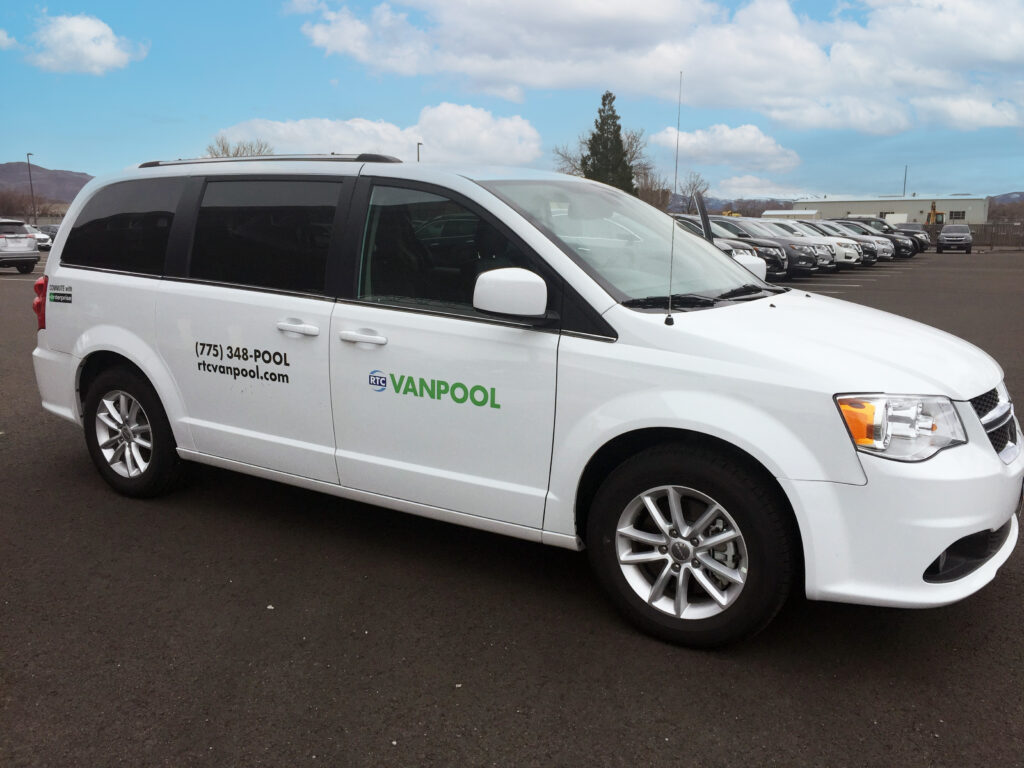
In today’s competitive business environment, companies in Washoe County are on the lookout for cost-effective ways to improve employee retention, satisfaction, and attendance. One growing strategy that delivers on all three fronts is incentivizing employees to participate in a regional carpool initiative like the Regional Transportation Commission (RTC) of Washoe County’s Vanpool program.
Fabian Delgado is a material handler at Tesla who started using RTC’s Vanpool program in 2017.
“It’s a lifesaver,” Delgado said. “It’s a blessing for me and it has helped me in the long run.”
Introduced in 2005, RTC’s Vanpool program addresses the needs of commuters like Mr. Delgado who want to enjoy a convenient, stress-free and less expensive commute. By organizing a group of 4 to 14 people with similar travel patterns, users can save money and ease traffic congestion.
For Delgado, the benefits extend way beyond convenience.
“It’s less cars on the road, so less congestion,” Delgado said. “If you have a vehicle it’s going to save you wear and tear, gas, and your time.”
Long commutes are proven to be a top stressor for employees, often leading to burnout, lateness, and lower job satisfaction. By encouraging employees to use RTC Vanpool, workers are offered a more relaxing and social alternative to solo driving. Employees arrive at work less stressed and more energized, and since the program allows riders to split commuting duties and costs, participants feel a stronger sense of community and support among their colleagues.
“We’ve seen businesses that subsidize or incentivize Vanpool participation stand out as forward-thinking employers that care a lot about their teams’ well-being,” RTC Trip Reductions Specialist Scott Miklos said. “It’s an effective and affordable perk for recruitment and retention, which is vital in today’s market.”
Plus, employees agree the increased camaraderie is a big bonus.
“I have become good friends with a lot of these people,” Delgado said. “You build a bond with your coworkers.”
One of the strongest financial arguments for vanpool incentives is rooted in tax law. The IRS allows employers to offer transportation benefits—like vanpool subsidies—on a pre-tax basis. That means you can provide vanpooling incentives of up to $315 per employee per month (as of 2025) without paying payroll taxes on those dollars. Employees also save on income tax, making the benefit even more attractive.
As large industrial developments like the Tahoe Reno Industrial Center (TRIC) attract more employees to Northern Nevada, RTC Vanpool has seen a significant rise in demand.
“We are ninth in the nation in passenger trips,” Miklos said. “Currently we’re ahead of Chicago, Houston and Washington DC.”
Another attractive incentive for businesses that may not be Tesla-sized are the sustainability benefits. More customers, investors, and employees are holding companies accountable for their environmental impact than ever before.
Each RTC Vanpool vehicle can eliminate up to 10 tons of carbon dioxide emissions per year, a powerful story for potential stakeholders.
“We removed over 15 million pounds of carbon dioxide in the past year,” Miklos said. “It’s even as impactful as our bus program.”
Investing in Vanpool also is an investment in the local economy – less traffic means faster delivery times, smoother logistics, and greater productivity by strengthening connections between neighborhoods and job centers all while making it easier for businesses to tap into a wider talent pool.
For Fabian Delgado, RTC Vanpool has become a much-appreciated part of his daily life.
“You build connections – you build friendships in the long run,” Delgado said. “It’s a no-brainer.”
Get started today! Incentivizing RTC Vanpool participation is a strategic move that delivers measurable returns: happier employees, lower costs, and a stronger reputation. Best of all, RTC provides support for every step of the way—from route planning to rider coordination—making implementation seamless.
Don’t wait for traffic congestion and employee turnover to become costly problems. Join the growing number of Washoe County businesses investing in smarter, cleaner, and more efficient commuting solutions.
Businesses looking to learn more about implementing RTC Vanpool programs for their employees can learn at www.rtcwashoe.com/vanpool, or by contacting Scott Miklos at smiklos@rtcwashoe.com.